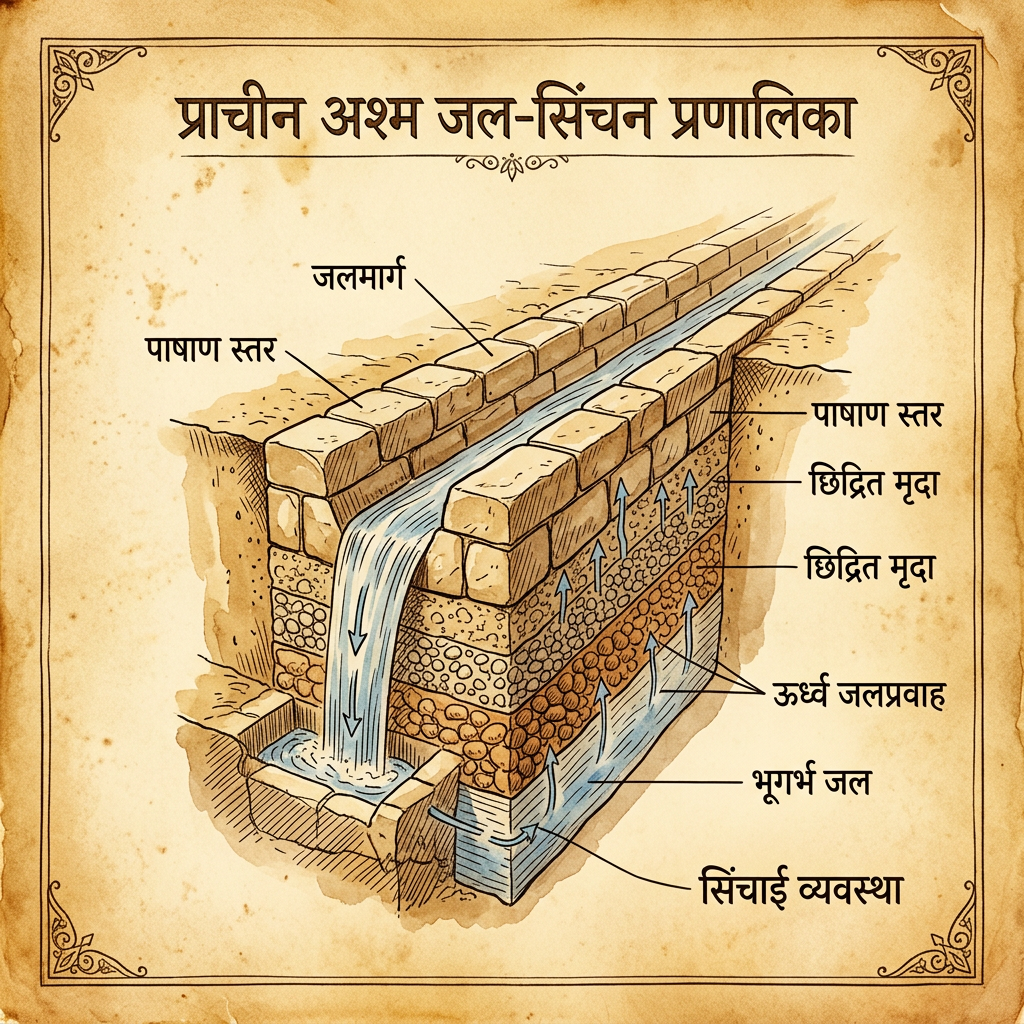
Researchers using the Atal AI Paleography Suite have successfully reconstructed several charred 8th-century birch-bark fragments found in the Bundelkhand region of Central India. Written in the Kutila script, the fragments belong to a lost work on hydrological physics titled Sushma-Jala-Vidya. The text outlines the principles of capillary action and surface tension, describing how water rises through porous media like clay and fine sand.
The manuscript details the construction of "self-watering" agricultural terraces that utilize these principles to draw moisture from deeper subterranean channels during periods of surface drought. This discovery provides the first theoretical basis for the advanced moisture-retention techniques observed in medieval Indian step-wells and garden systems, proving that these engineering marvels were based on a formal scientific understanding of fluid mechanics at a microscopic scale.