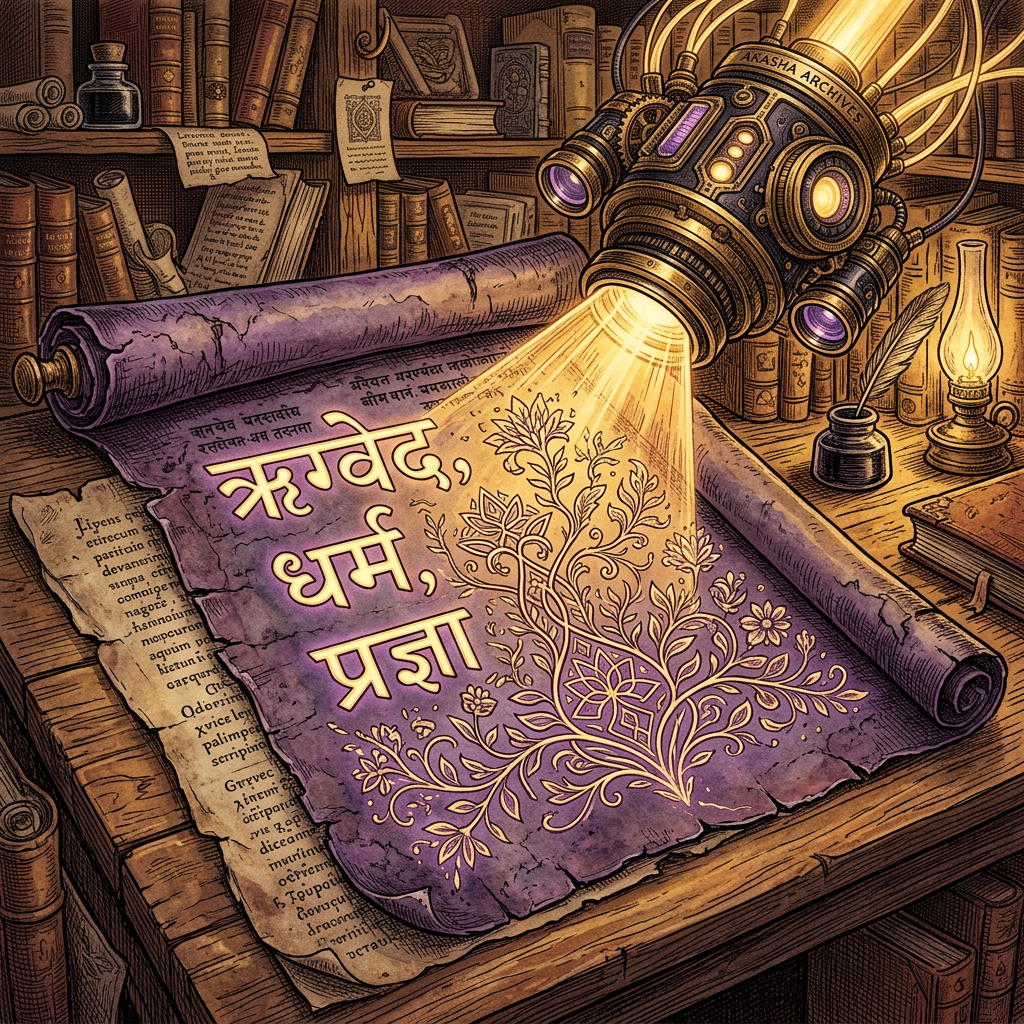
Using advanced multi-spectral imaging and AI-based linguistic models, researchers at the Oxford Centre for Hindu Studies have successfully decoded a series of palimpsest fragments found in the Dunhuang caves. The manuscripts, written in a rare 8th-century Siddham script, contain unrecorded Sanskrit treatises detailing the mathematical modeling of biological growth patterns, specifically focusing on the recursive structures of leaves and seeds. The texts describe concepts that parallel modern Fibonacci sequences and phyllotaxis.
Scholars believe these works were authored by lost scholars of the Nalanda tradition and were transported along the Silk Road during the height of Indo-Tibetan exchange. The discovery challenges the notion that ancient biological science was purely descriptive, revealing a sophisticated attempt to apply Ganita (mathematics) to the fundamental principles of Prana-Vijnana (life science). This breakthrough opens new avenues for understanding the intersection of ancient philosophy and natural observation in the medieval period.