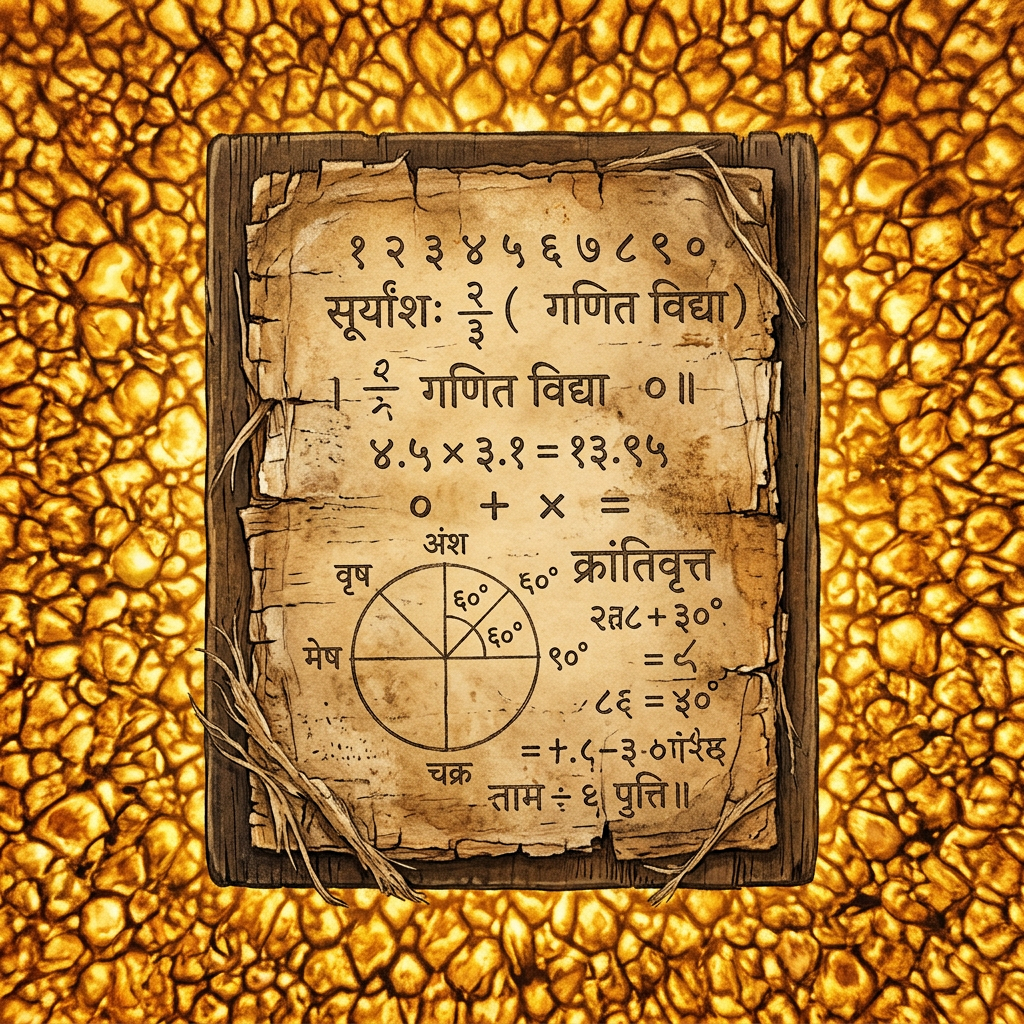
A breakthrough study published in The Journal of Astronomical History and Heritage has identified sophisticated mathematical models within 11th-century Jyotir-Nibandha manuscripts. Researchers from the Indian Institute of Astrophysics utilized AI-driven spectral analysis to interpret complex Sanskrit notations that describe the turbulent, grain-like structures on the solar surface, known today as solar granulation. These ancient algorithms suggest that medieval Indian astronomers were employing iterative numerical methods to account for rapid changes in solar luminosity centuries before the advent of modern telescopes.
The research demonstrates that the authors of the manuscript used a base-10 positional system to calculate the frequency and distribution of these solar features. By correlating the descriptions with high-resolution historical solar data, the study validates the observational precision of the Siddhantic tradition. This discovery redefines our understanding of early Indian solar physics, highlighting a transition from purely observational astronomy to predictive modeling of complex stellar phenomena.