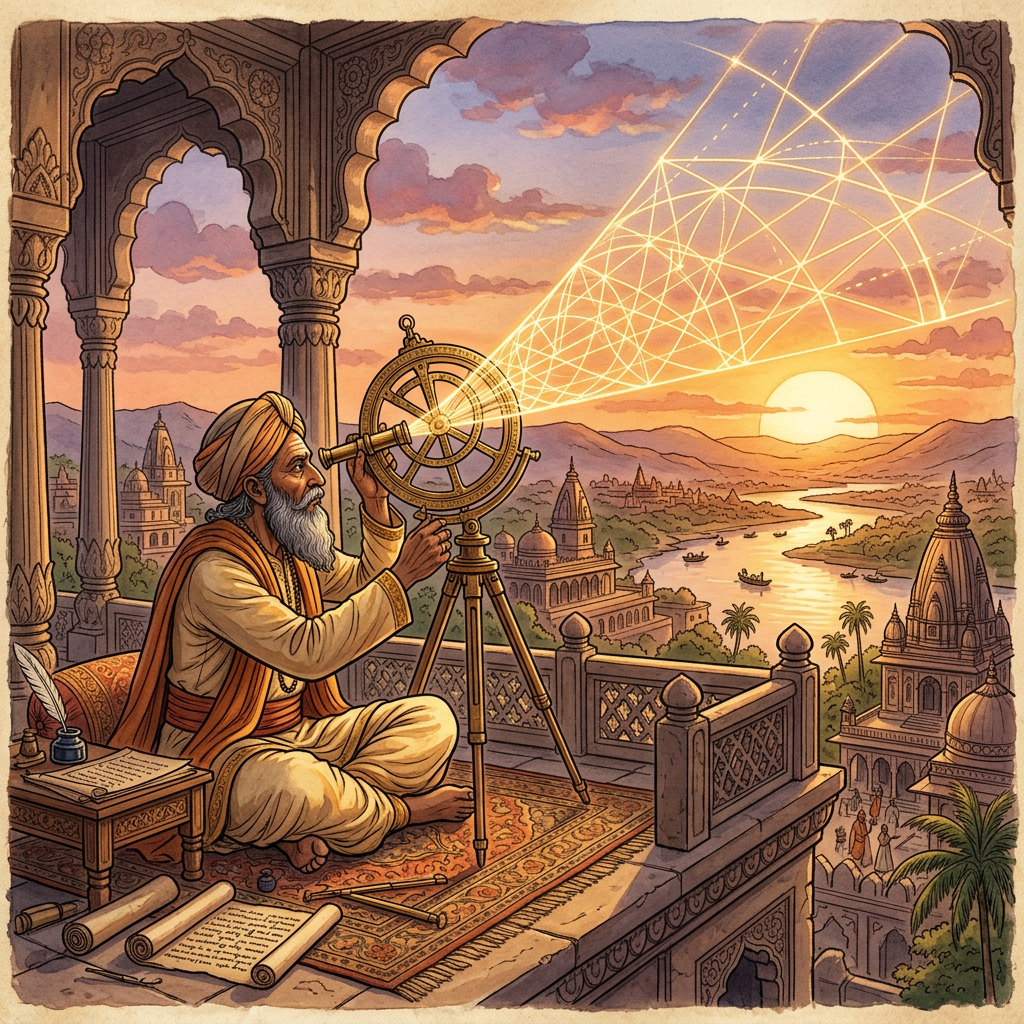
New research published in the Journal of Archaeological Science has applied computational modeling to a rare 11th-century Sanskrit manuscript, the Siddhanta-Kalpavalli. The study identifies previously overlooked algorithms designed to calculate the bending of light as it passes through the atmosphere. These mathematical shortcuts allowed ancient astronomers to correct for visual distortion when observing celestial bodies near the horizon, achieving an accuracy comparable to much later European techniques.
The research team utilized non-linear algebraic solvers to verify the formulas found in the text, confirming that the Sanskrit algorithms effectively modeled the varying density of air layers at different altitudes. This indicates that Indian mathematicians had developed a theoretical framework for atmospheric optics centuries before the invention of the telescope, integrating physics and geometry into their ritual and observational practices.