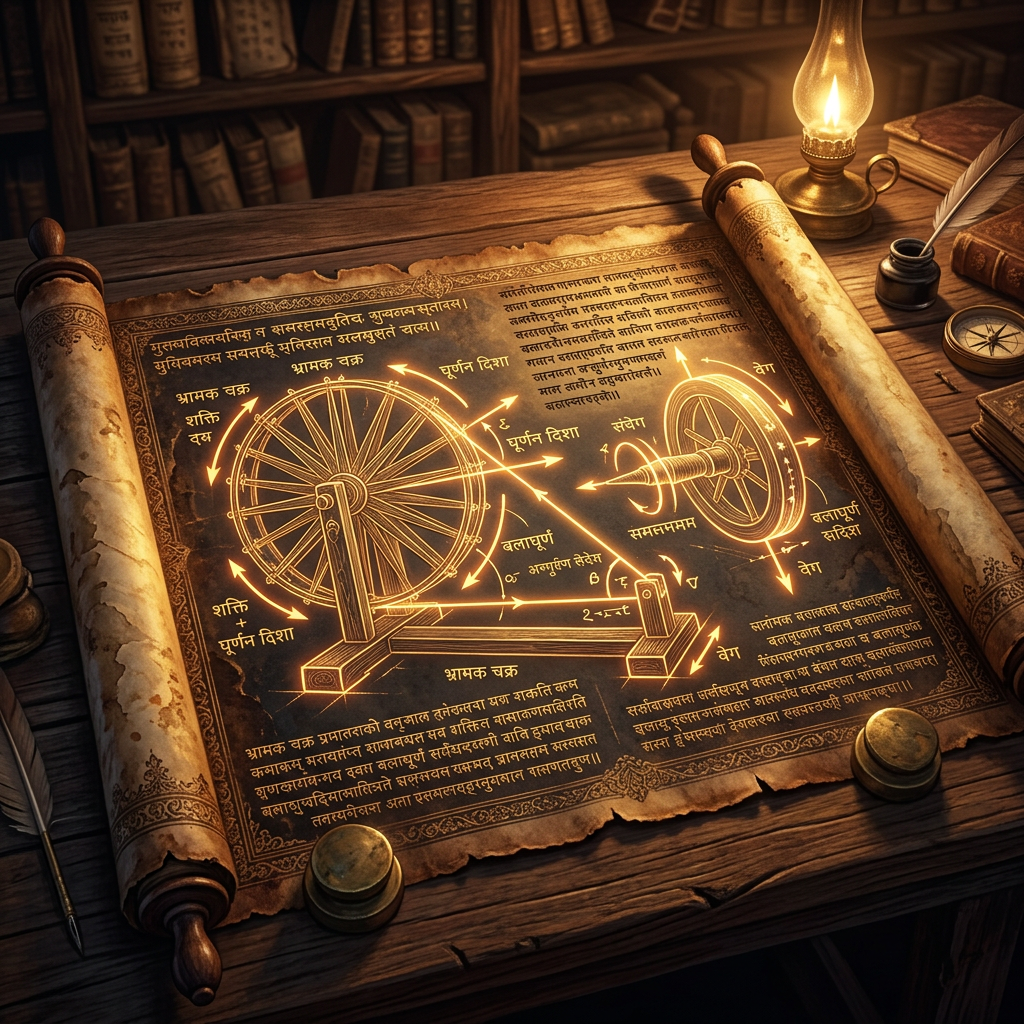
Digital archaeologists have utilized multispectral imaging and Machine Learning to reconstruct a 5th-century Sanskrit palimpsest found in a private library in Ujjain. The underlying text, written in Proto-Sharada, contains a previously unknown treatise on the mechanics of rotating bodies. The text outlines theoretical models for Angular Momentum as applied to the design of ancient vertical-axis water wheels and weaving spindles.
The treatise, titled Ghrunana-Yantra-Vidhi, describes how the distribution of mass in a spinning wheel affects its stability and torque. Scholars believe this discovery proves that ancient Indian mechanics were not merely empirical but based on a formal, albeit early, understanding of rotational physics. The reconstruction effort has unveiled several geometric diagrams that correlate with modern principles of moment of inertia.