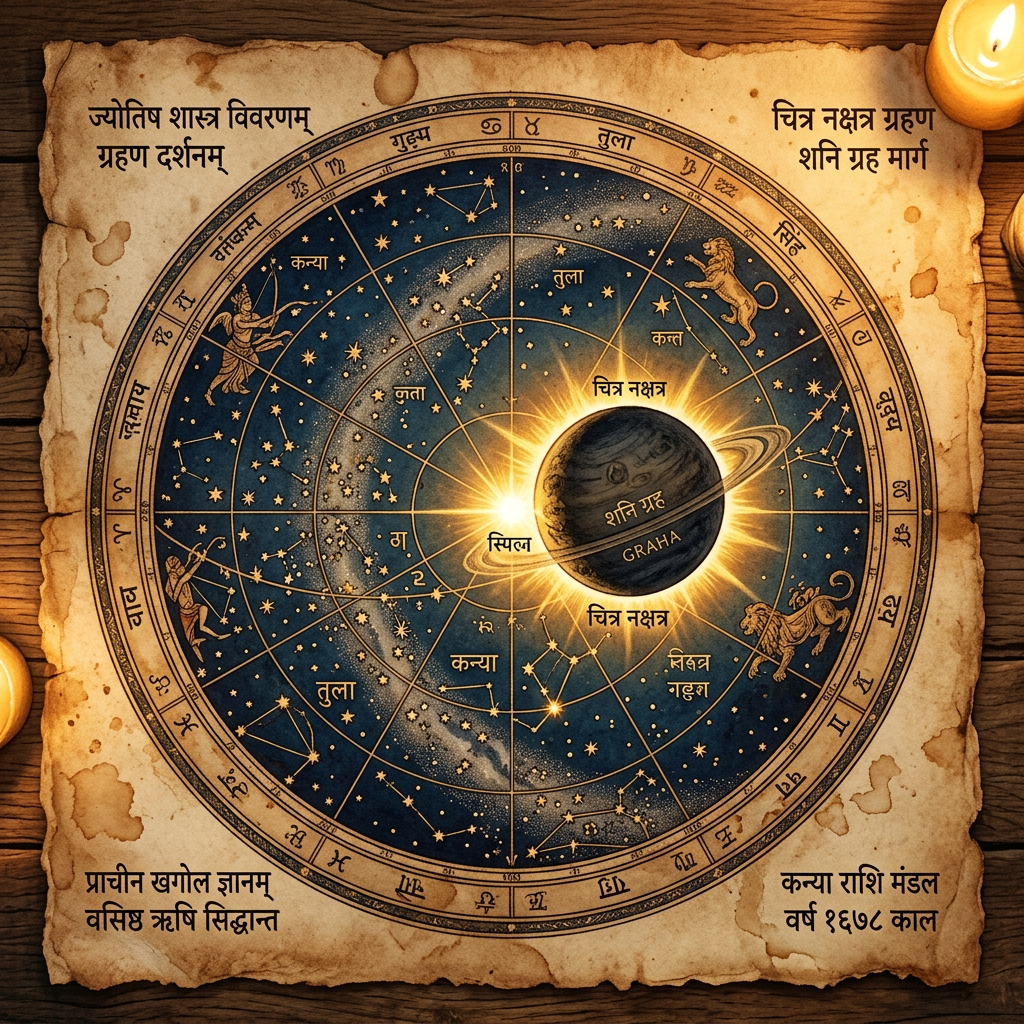
A joint study by the Indian Institute of Astrophysics and the Archeological Survey of India has identified a precise astronomical alignment described in several cryptic verses of the Rigveda. By using high-fidelity celestial simulations, the researchers found that the text provides a detailed account of a rare planetary occultation of the star Spica (Chitra) by Jupiter, which occurred with mathematical precision in the year 2950 BCE. This finding provides a new chronological anchor for the composition of early Vedic layers, pushing back the timeline of systematic astronomical observation in the Indian subcontinent.
The study demonstrates that the authors of these hymns utilized a sophisticated observational framework to track the retrograde motion of planets relative to the lunar mansions (Nakshatras). The precision of the descriptions matches the theoretical calculations of non-linear planetary perturbations that would have been visible to the naked eye under the clear skies of the third millennium BCE. This research challenges previous assumptions about the observational limits of ancient civilizations and validates the Rigveda as a repository of early scientific data.