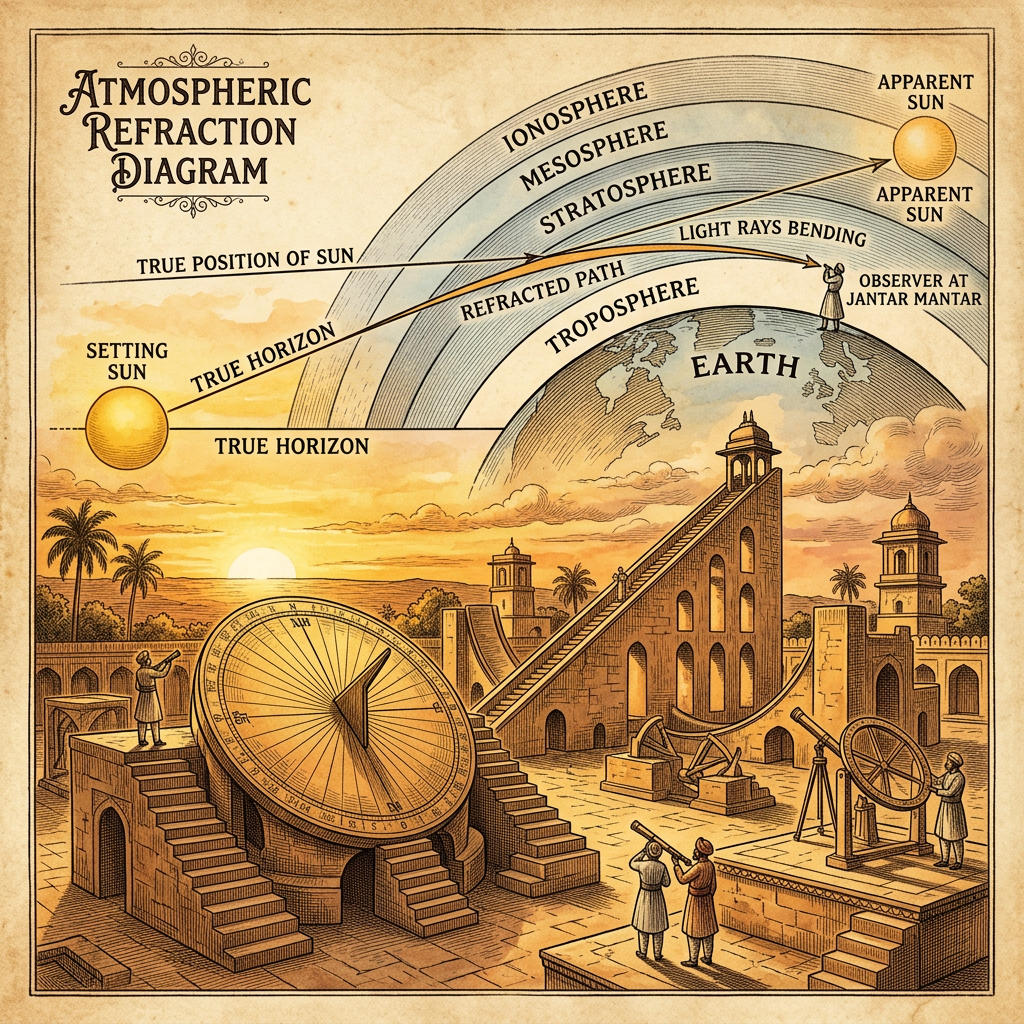
New research published in the Journal of Astronomical History and Heritage highlights the precision of 12th-century Sanskrit treatises in modeling atmospheric refraction near the horizon. By analyzing the Siddhanta-Siromani, scholars have identified complex geometric corrections used to predict the exact timing of sunrise and solar eclipses when the sun is at low altitudes.
The study demonstrates that medieval Indian astronomers used spherical trigonometry to calculate how light bends as it passes through different layers of the atmosphere. This knowledge allowed for high-precision celestial observations that were not replicated in European astronomy until the 17th century. The researchers used modern computational models to validate that these ancient algorithms are accurate to within a fraction of a degree.