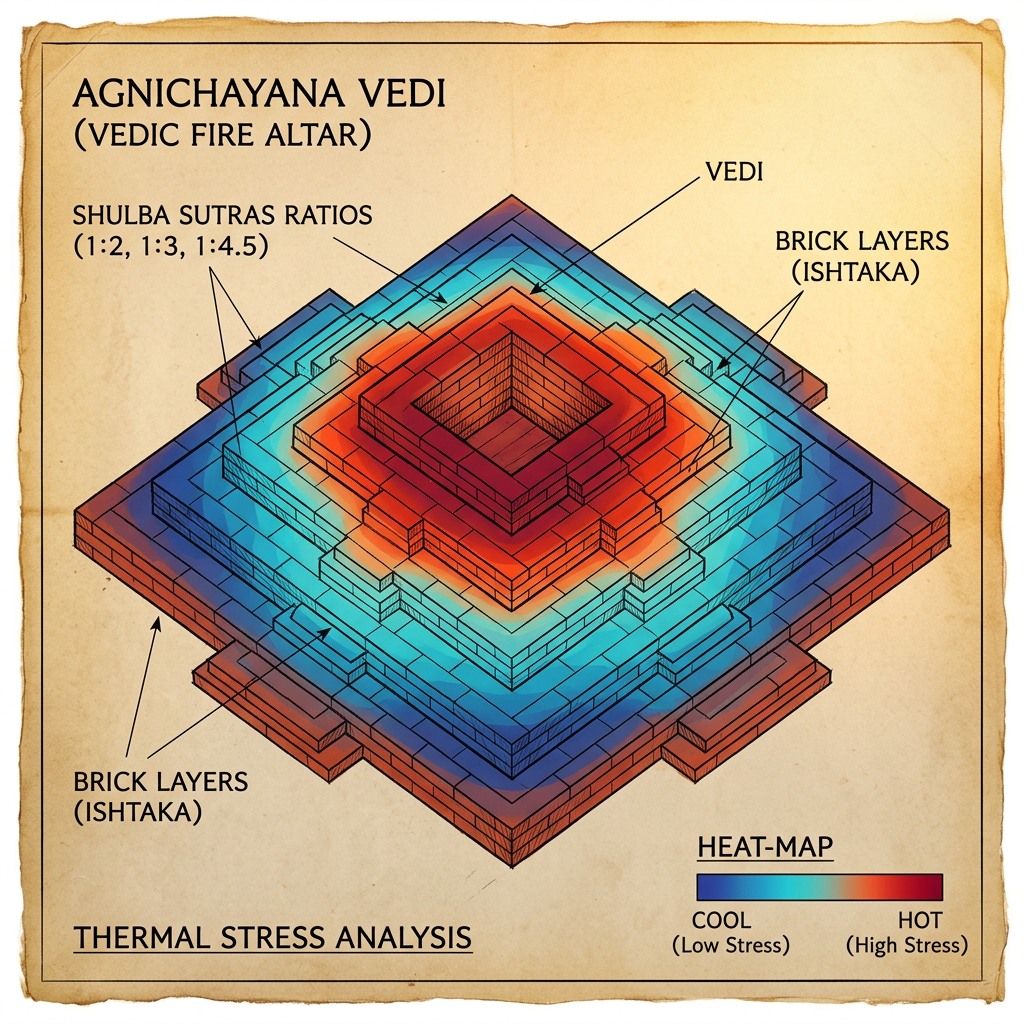
New research published in the Journal of Archaeological Science has identified sophisticated mathematical logic within the Baudhayana Sulba Sutras, specifically regarding the construction of ritual fire altars. Computational modeling of the precise geometric dimensions described in the Sanskrit texts reveals that the ancient designers utilized recursive algorithms to account for non-linear thermal expansion in the composite clay and brick materials used during sacrificial rituals. This ensured the structural integrity of the altars despite extreme heat fluctuations during prolonged ceremonies.
The study demonstrates that the Sanskrit authors possessed a quantitative understanding of material science that predates similar Western developments by over a millennium. By applying modern stress-test simulations to the ritual designs, researchers found that the specific ratios and interlocking patterns of the bricks optimized heat dissipation across the surface. This scholarly breakthrough shifts the perception of the Sulba Sutras from purely ritualistic geometry to a sophisticated manual of applied physics and structural engineering in ancient India.