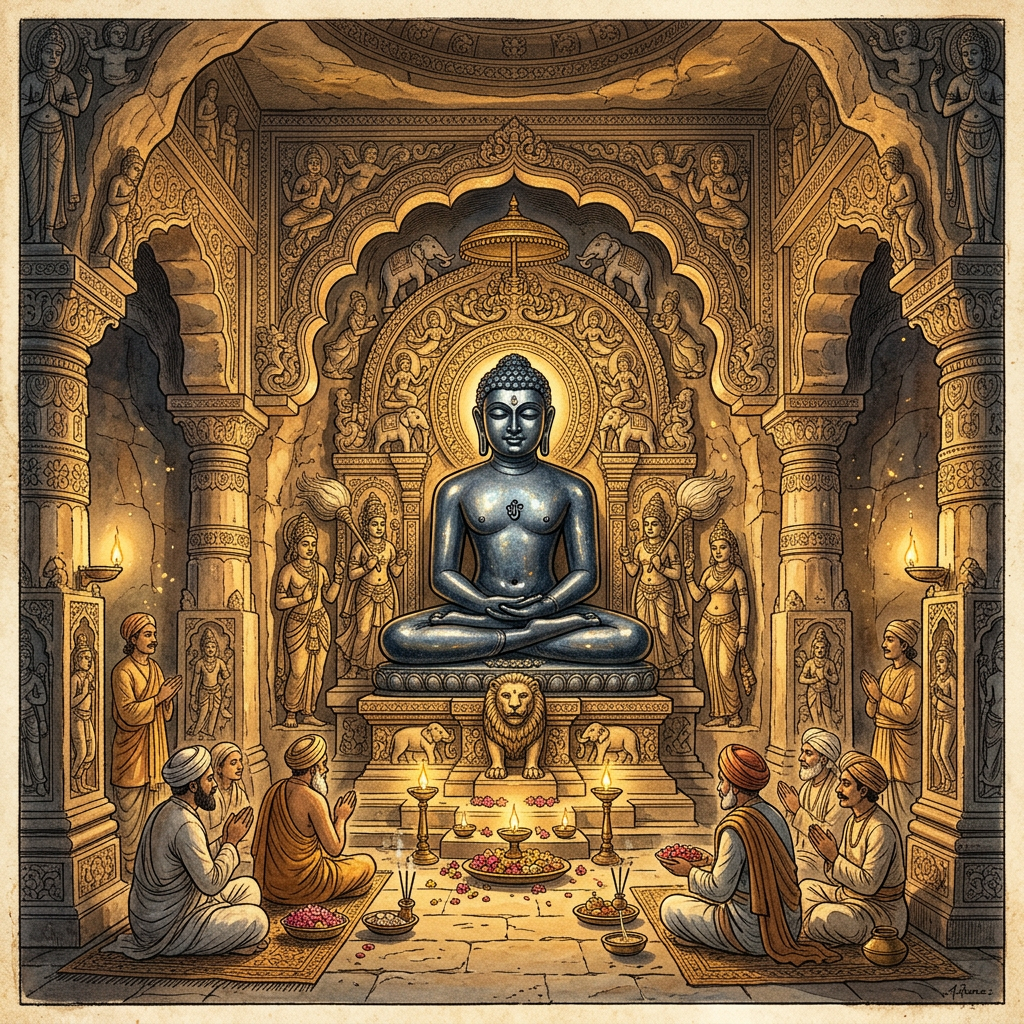
Archaeologists exploring the Satmala hill range in Northern Maharashtra have discovered a pristine Jain Basadi (temple) belonging to the Rashtrakuta era. The temple, carved directly from the basalt cliffside, contains a sanctuary housing five large Tirthankara idols crafted from a rare, high-polish blue-hued basalt. This discovery is significant as it highlights the expansion of Rashtrakuta religious patronage in remote mountainous regions and the advanced stone-working techniques of the 8th century.
The temple's ceiling is adorned with complex geometric mandalas and friezes illustrating scenes from the Mahapurana. Preliminary analysis of the site suggests that the temple was once part of a larger monastic complex that served as a retreat for Jain ascetics. Conservation efforts are now underway to address water seepage within the cave sanctuary, and local authorities are working to include the site in a new protected heritage corridor for ancient cave architecture.