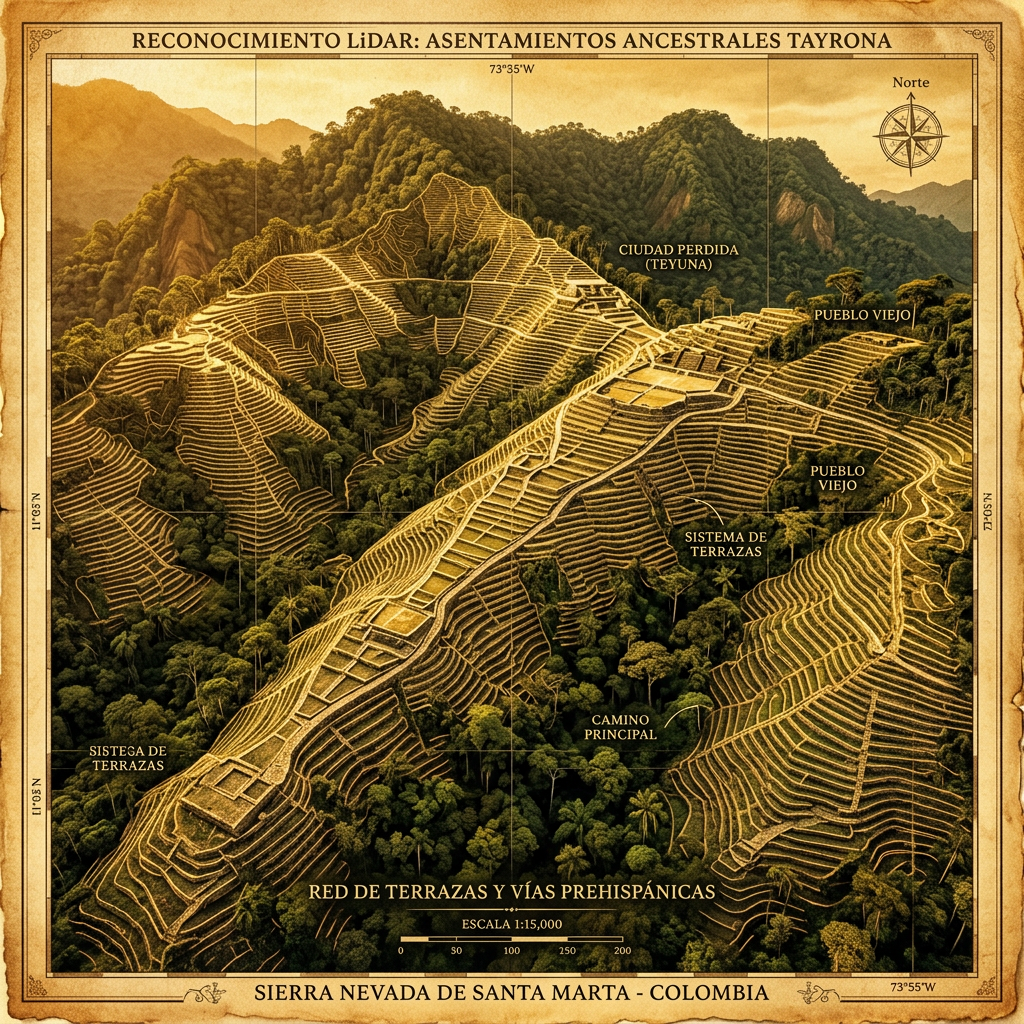
A breakthrough LiDAR survey in the dense, high-rainfall Chocó rainforest of western Colombia has revealed a sprawling urban network hidden beneath the canopy. Dubbed 'The Emerald Metropolis', the site features over 4,000 interconnected terraces, raised defensive roads, and a central ceremonial plaza surrounded by pyramidal mounds. The discovery points to a previously unknown maritime-linked culture that flourished between 500 and 1000 CE, thriving in one of the wettest environments on Earth through advanced water management systems.
Unlike the well-documented stone cities of the Andes, this lowland civilization relied on a hybrid of volcanic stone and earthwork engineering to combat the region's heavy erosion. Archaeologists noted that the urban grid is oriented toward the setting sun of the winter solstice, indicating a sophisticated understanding of astronomy. This find significantly expands the known map of pre-Columbian urbanism, showing that the Chocó jungle was a major center of population and power rather than a peripheral wilderness.