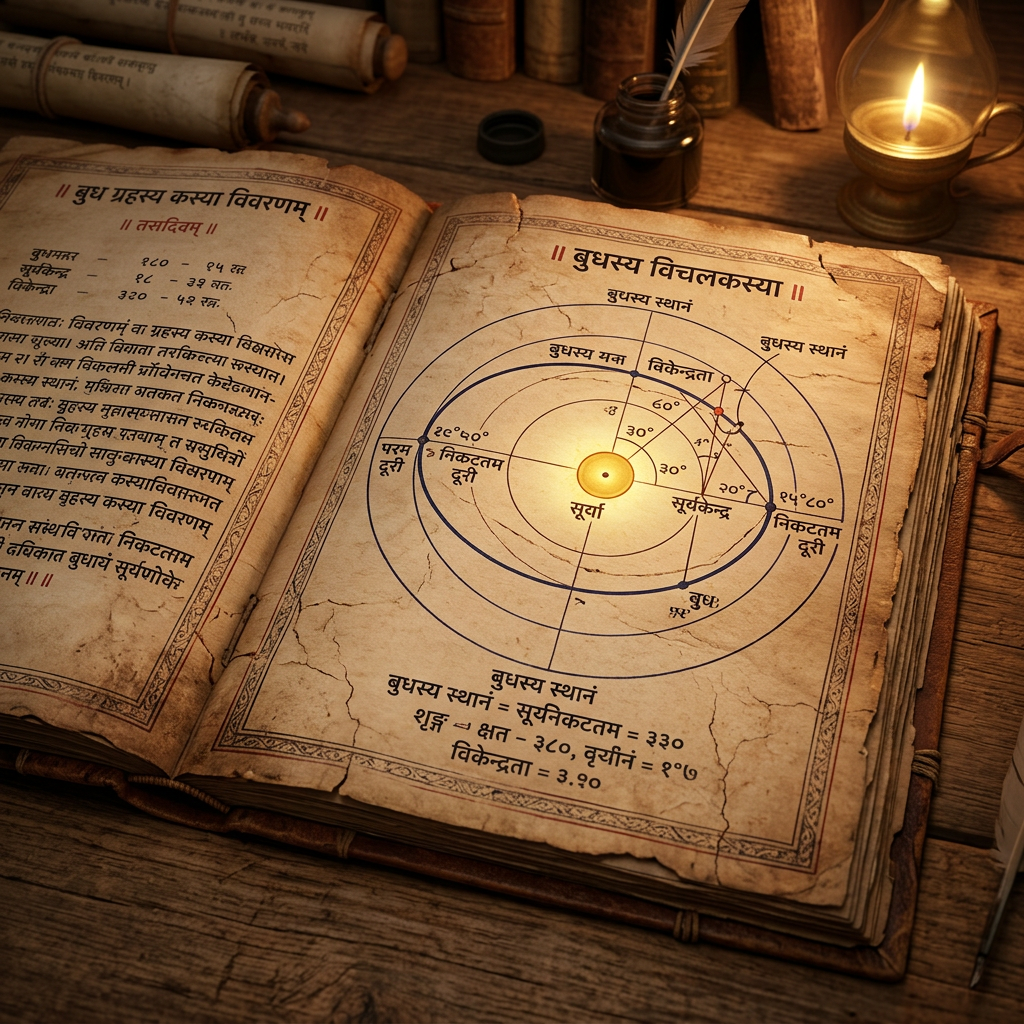
A breakthrough study published in the Journal of Ancient Mathematical Sciences has unveiled the sophisticated numerical methods contained within the Karana-Prakashika, a 12th-century Sanskrit astronomical treatise. Researchers used high-performance computing to simulate the planetary models described in the text, discovering that ancient Indian astronomers had developed specific iterative corrections to account for the complex orbital resonance of Mercury. These algorithms demonstrate a level of mathematical precision that allowed for the prediction of planetary positions with an error margin of less than 0.05 degrees, significantly more accurate than contemporaneous models in other civilizations.
The research highlights how the Karana-Prakashika utilized a unique system of sine-table interpolation and non-linear velocity adjustments. By analyzing multiple palm-leaf variants found in temple archives across Karnataka, the team reconstructed a lost chapter dedicated to the 'Perturbation of the Inner Planets.' This find suggests that the Kerala School of Astronomy's precursors were already grappling with the three-body problem in a nascent, algorithmic form centuries before the development of modern calculus.