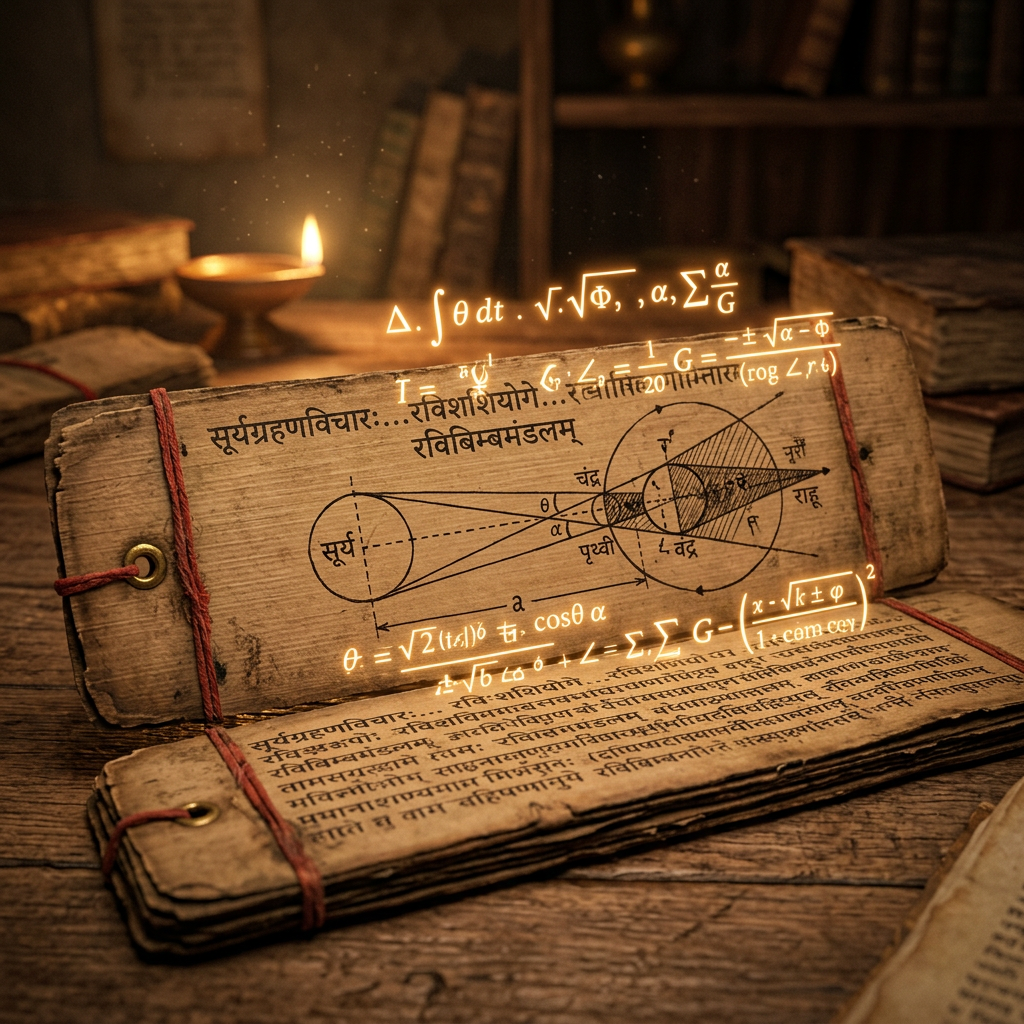
A team of computational historians and astronomers from the Indian Institute of Science (IISc) has unveiled a groundbreaking analysis of the 10th-century Sanskrit treatise Karana-Kautuka by Brahmagupta’s successors. Using high-performance AI modeling, the researchers identified previously unrecognized recursive algorithms designed to calculate the non-linear obscuration of the solar disc during partial eclipses with a degree of accuracy that matches modern geometric optics.
The study highlights how ancient Indian mathematicians utilized early forms of iterative approximation to account for the Earth's curvature and atmospheric refraction simultaneously. These findings suggest that 10th-century Sanskrit astronomy possessed a formal mathematical framework for modeling dynamic light-interference patterns, predating similar developments in European theoretical optics by over seven centuries.