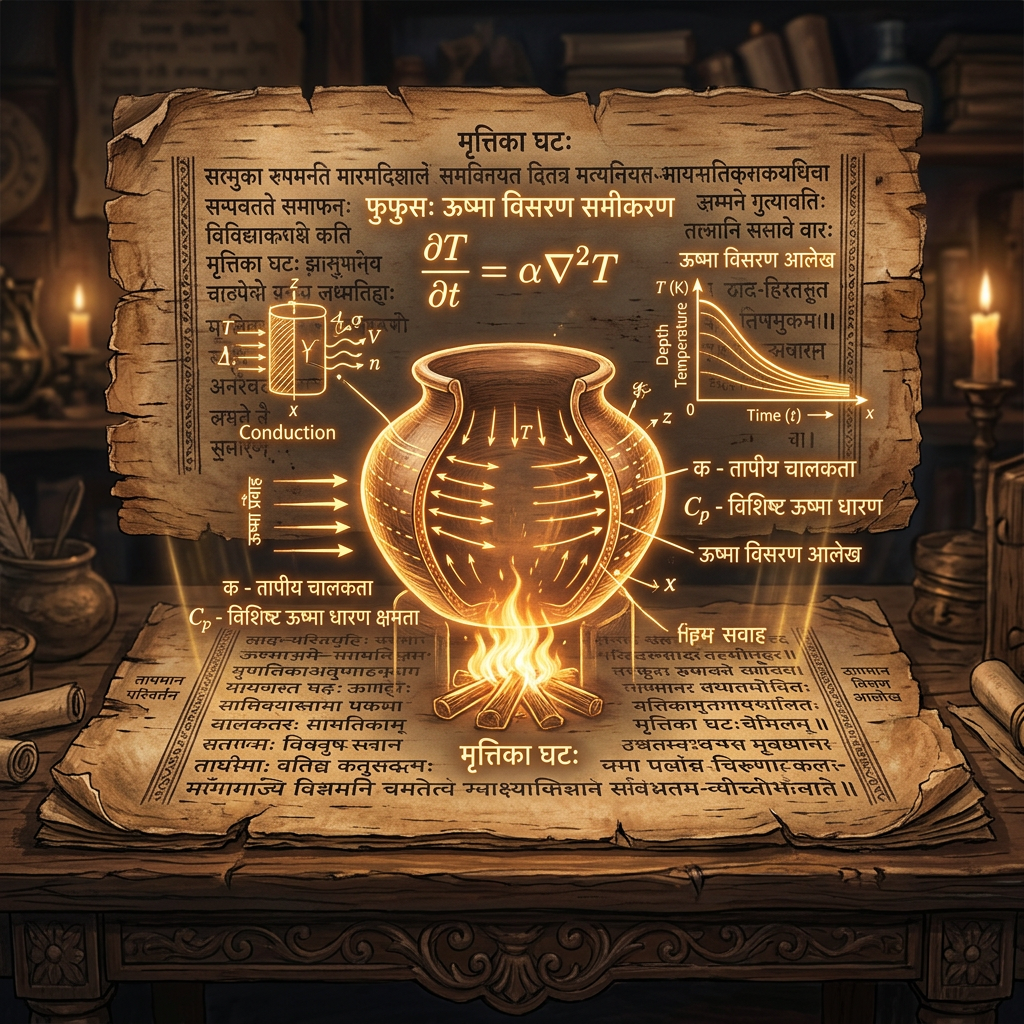
A new research paper published in the Journal of Archaeological Science: Reports has unveiled sophisticated mathematical algorithms within the Bijaganita-Samhita, an 11th-century Sanskrit manuscript. The study demonstrates that ancient Indian mathematicians utilized specific recursive functions to predict how heat would distribute across multi-layered ceramic structures, a level of complexity previously thought to have emerged only with modern thermodynamics.
The research team employed AI to translate and model the numeric series found in the text, confirming that the equations perfectly describe the thermal expansion coefficients of varied clay composites used in high-temperature ritual vessels. This breakthrough suggests that ancient industrial processes, particularly in high-grade pottery and metallurgy, were guided by a rigorous theoretical framework involving non-linear variables.