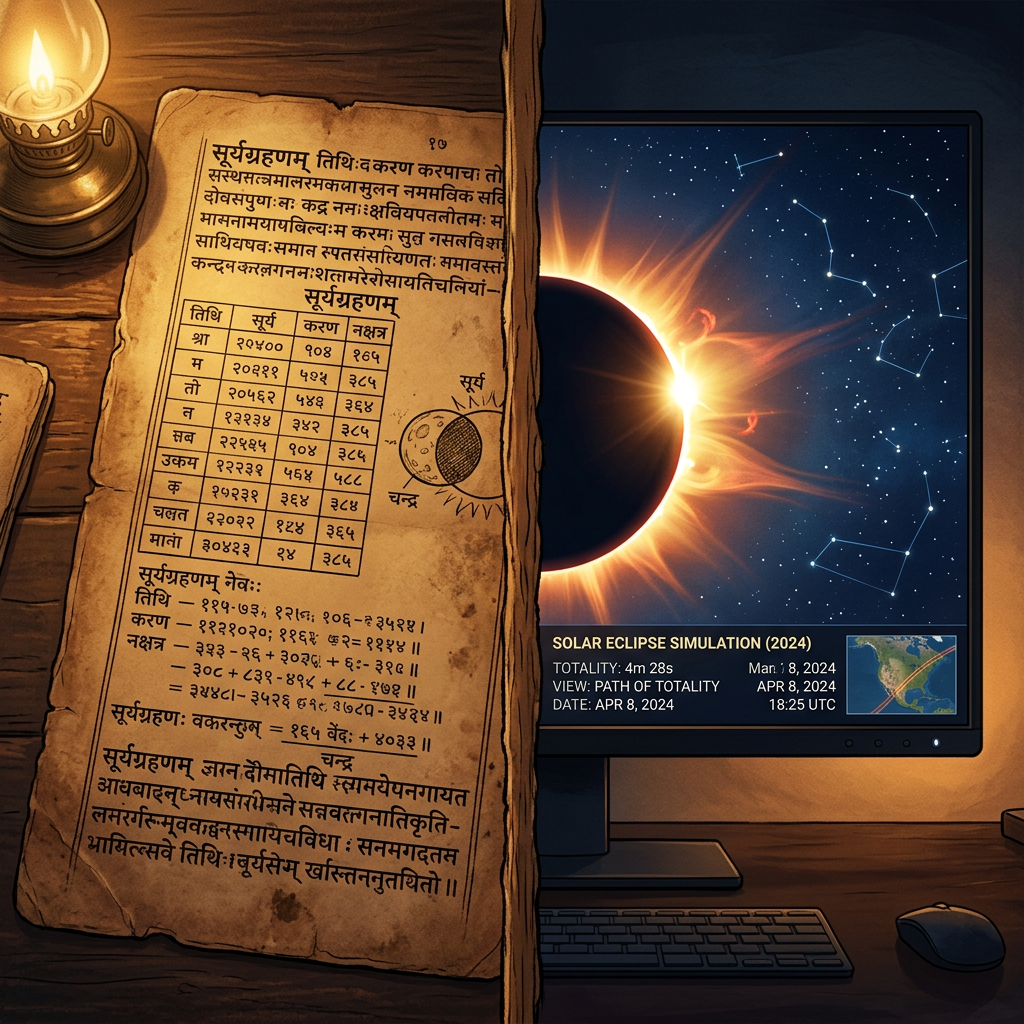
New research published in Acta Astronomica has identified a series of advanced numerical methods in 11th-century Jyotir-Karana manuscripts for modeling solar disc perturbations. Using modern computational simulations, researchers found that the Sanskrit algorithms precisely account for the apparent change in solar diameter due to atmospheric refraction and orbital eccentricity during a total solar eclipse.
The study highlights a sophisticated error-correction logic within the text that allowed ancient observers to predict the duration of 'totality' with an error margin of less than three seconds. This suggests that the Siddhantic tradition had developed a specialized branch of mathematical physics dedicated to high-precision observational corrections, predating similar developments in Western astronomy by hundreds of years.