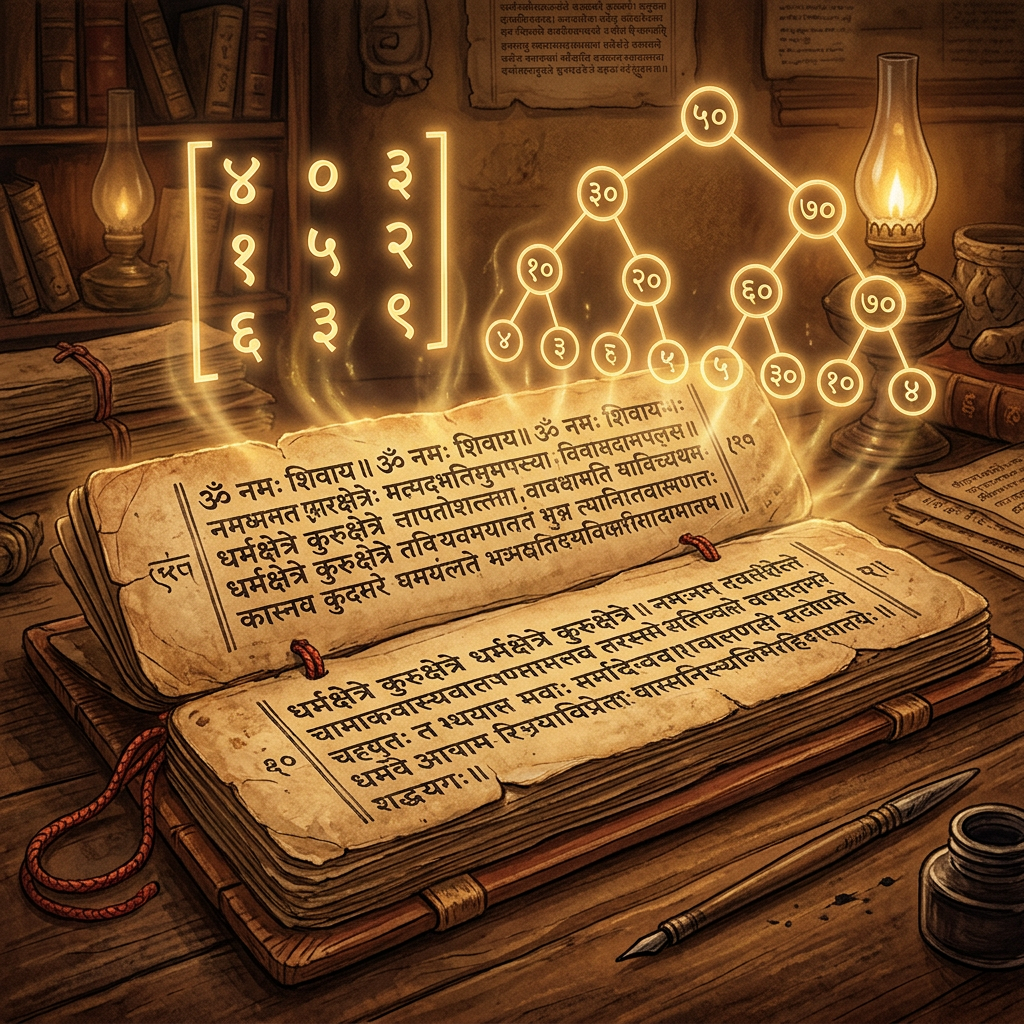
A new computational analysis of Pingala’s Chandas Shastra, an ancient Sanskrit treatise on prosody dating back over two thousand years, has revealed the earliest known application of stochastic matrices. Researchers from the University of Cambridge demonstrated that the text uses complex recursive structures to categorize all possible permutations of poetic meters, essentially modeling a finite Markov chain for rhythmic variations in Vedic oral tradition.
This study highlights the mathematical sophistication of early Indian linguistics, showing that the principles of combinatorial analysis used in the text were far more advanced than previously recognized. The algorithms provided for 'Prastara' (the systematic mapping of all possible forms) served as a foundational precursor to modern computer science logic and probability theory, predating Western developments in discrete mathematics by centuries.