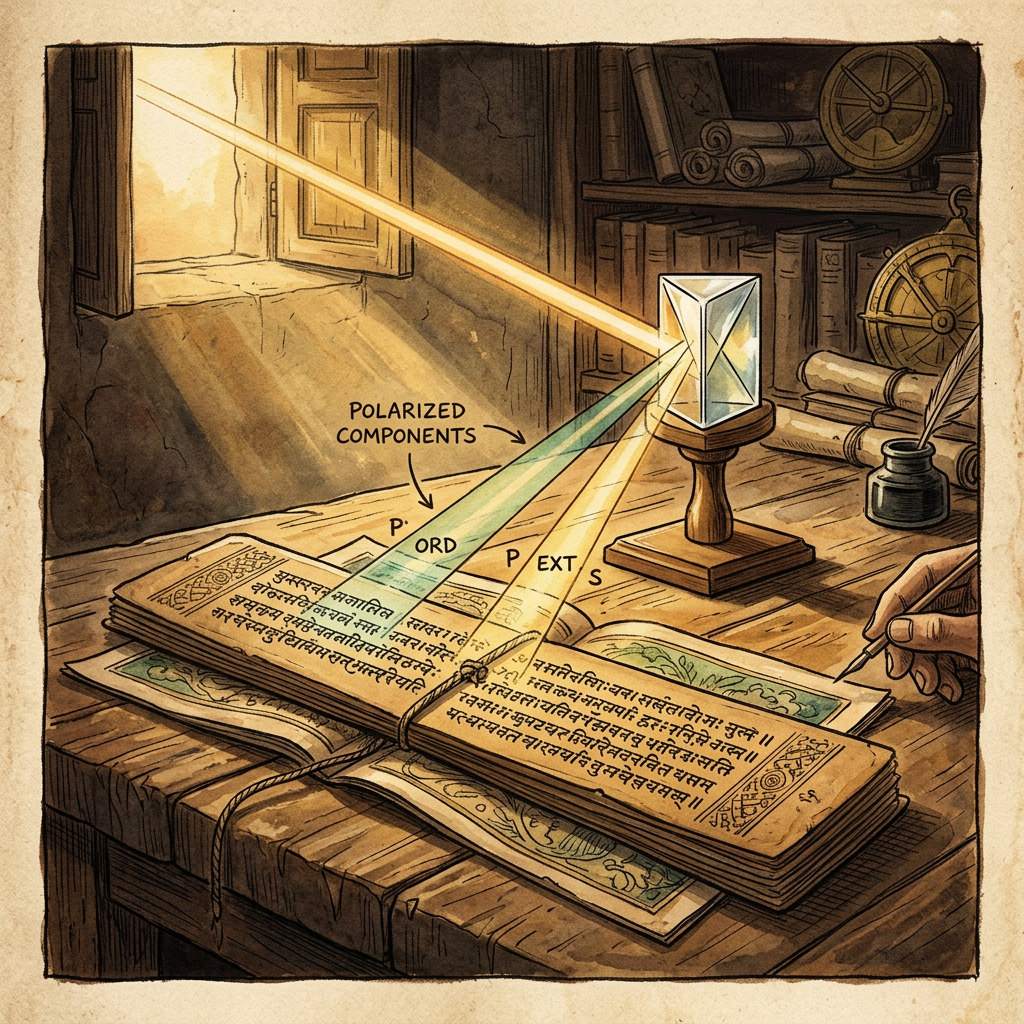
New research published in the Journal of Astronomical History has identified sophisticated mathematical models for light scattering in the 11th-century Sanskrit treatise Jyotir-Mahodadhi. Using advanced computational linguistics and ray-tracing simulations, scholars at the University of Cambridge have found that the text provides recursive algorithms to calculate the degree of atmospheric polarization during solar transitions at dawn and dusk.
The study highlights how ancient Indian astronomers utilized these models to refine their observations of planetary positions near the horizon, where refraction and scattering effects are most pronounced. These findings suggest that 11th-century Indian science possessed a theoretical understanding of the vectorial properties of light, predating similar concepts in European optics by several centuries.