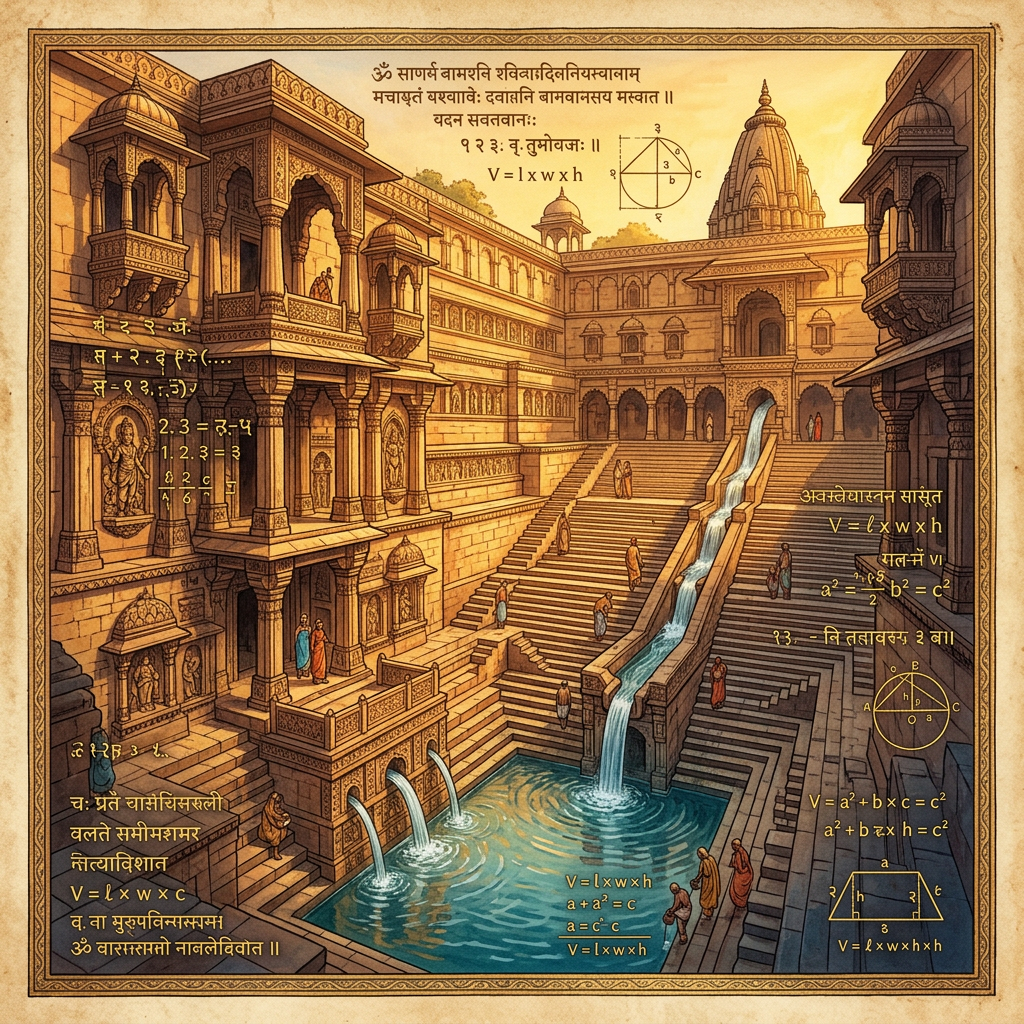
New research published in the Archive for History of Exact Sciences has analyzed 10th-century Bijaganita-Muktavali manuscripts, uncovering advanced Sanskrit methods for modeling non-linear fluid friction. The text provides a series of algebraic approximations for calculating the energy loss of water flowing through narrow conduits and sluice gates, which were essential for the design of the period's sophisticated temple reservoirs and step-wells.
The researchers used digital simulation to test the Sanskrit formulas against modern Navier-Stokes equations, finding a surprising level of correlation for low-velocity flows. This suggests that medieval Indian mathematicians had developed empirical laws for fluid resistance and surface tension that allowed for the construction of highly efficient gravity-fed water distribution networks across arid regions of the Deccan Plateau.