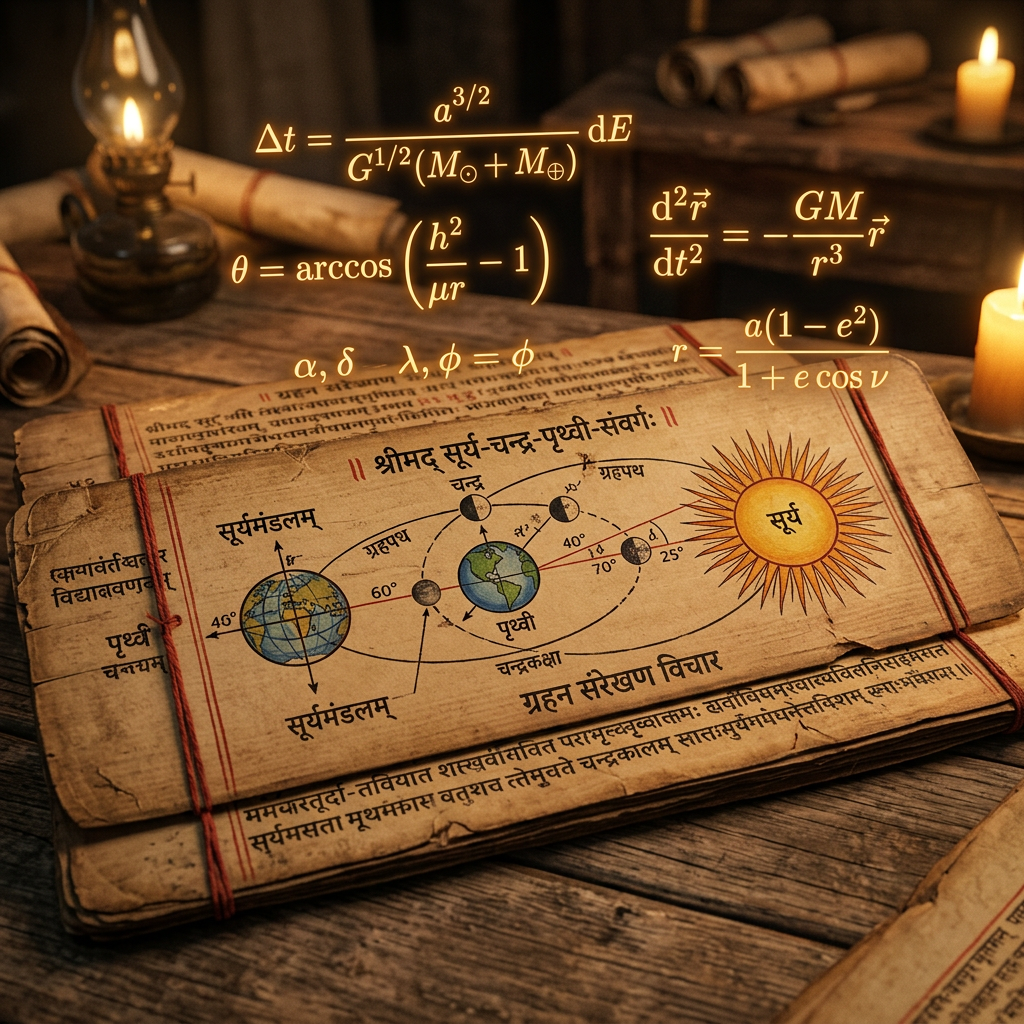
New research published in the Journal of Astronomical History and Heritage has unveiled highly sophisticated mathematical models within recently recovered fragments of the Bhaskara-Tantra. Using advanced computational paleography, scholars from the Indian Institute of Science have demonstrated that 11th-century Indian astronomers utilized recursive algorithms to predict the non-linear displacement of the lunar shadow during solar eclipses. These methods, which predated similar Western developments by several centuries, allowed for unprecedented precision in determining the path of totality across different latitudes.
The study indicates that the authors of the manuscript employed a unique geometric projection system to account for the Earth's curvature and varying orbital velocities. This breakthrough suggests that the medieval Siddhantic tradition possessed a deep understanding of perturbation theory applied to celestial mechanics. The findings are being hailed as a major milestone in the history of mathematics, illustrating the rigorous analytical framework used by ancient Indian scientists to solve complex problems in spherical trigonometry and orbital dynamics.