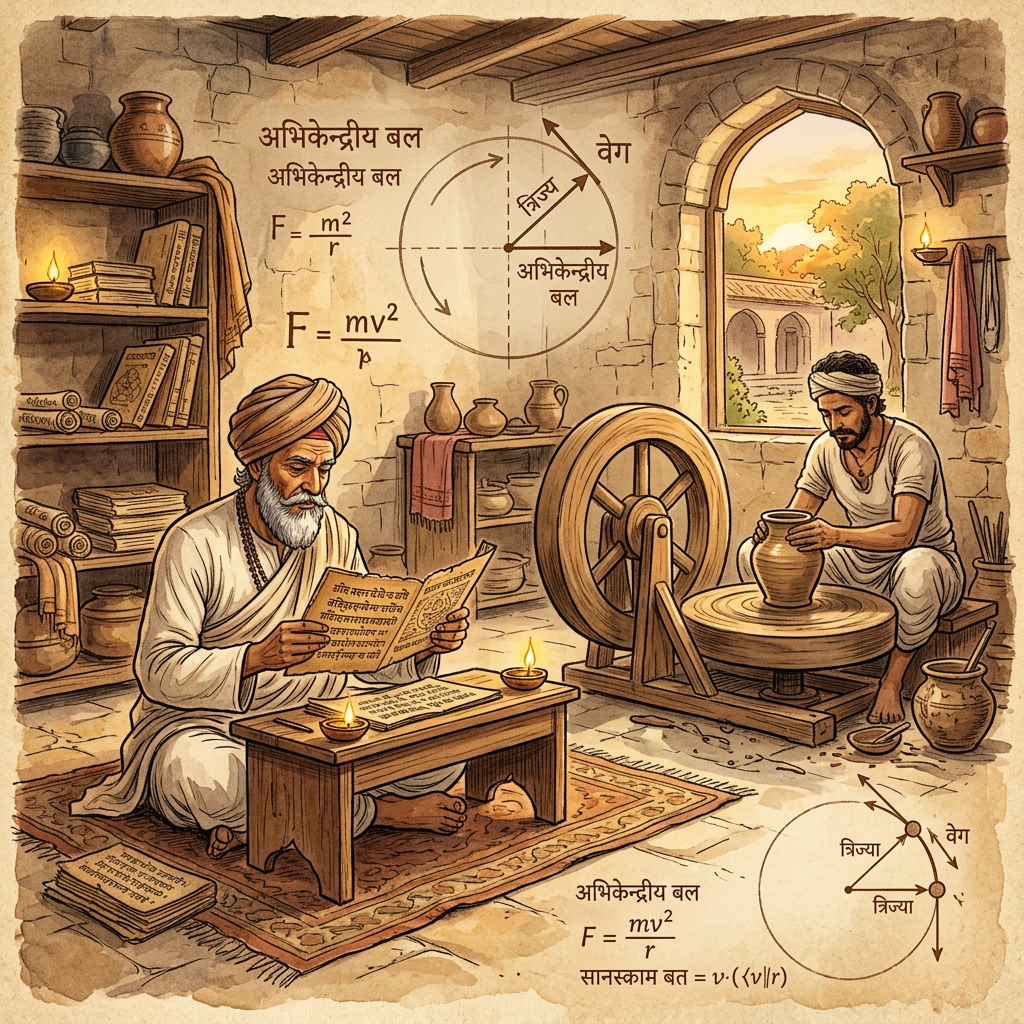
A breakthrough study published in the Journal of Archaeological Science has utilized advanced AI-driven paleographic tools to decipher a collection of fragmentary 9th-century birch-bark manuscripts in the Sharada script. The research, led by a collaborative team of Sanskrit scholars and mechanical engineers, reveals previously unknown theoretical discussions regarding the physics of angular momentum and rotational stability. The texts describe mathematical models for the optimization of 'Chakra-Yantra' (pottery wheels), focusing on how the distribution of mass in flywheels affects the consistency of centrifugal force during the shaping of high-walled vessels.
The study highlights that ancient Indian artisans and theorists possessed a sophisticated understanding of moment of inertia, centuries before similar principles were formalized in European classical mechanics. By analyzing the recursive algorithms described in the manuscripts, researchers were able to reconstruct the geometric proportions suggested for various types of ceramic production, suggesting a highly standardized industrial approach to pottery manufacturing in the medieval Himalayan region. This discovery provides a missing link between early Vedic geometric principles and the practical mechanical engineering of the 1st millennium CE.