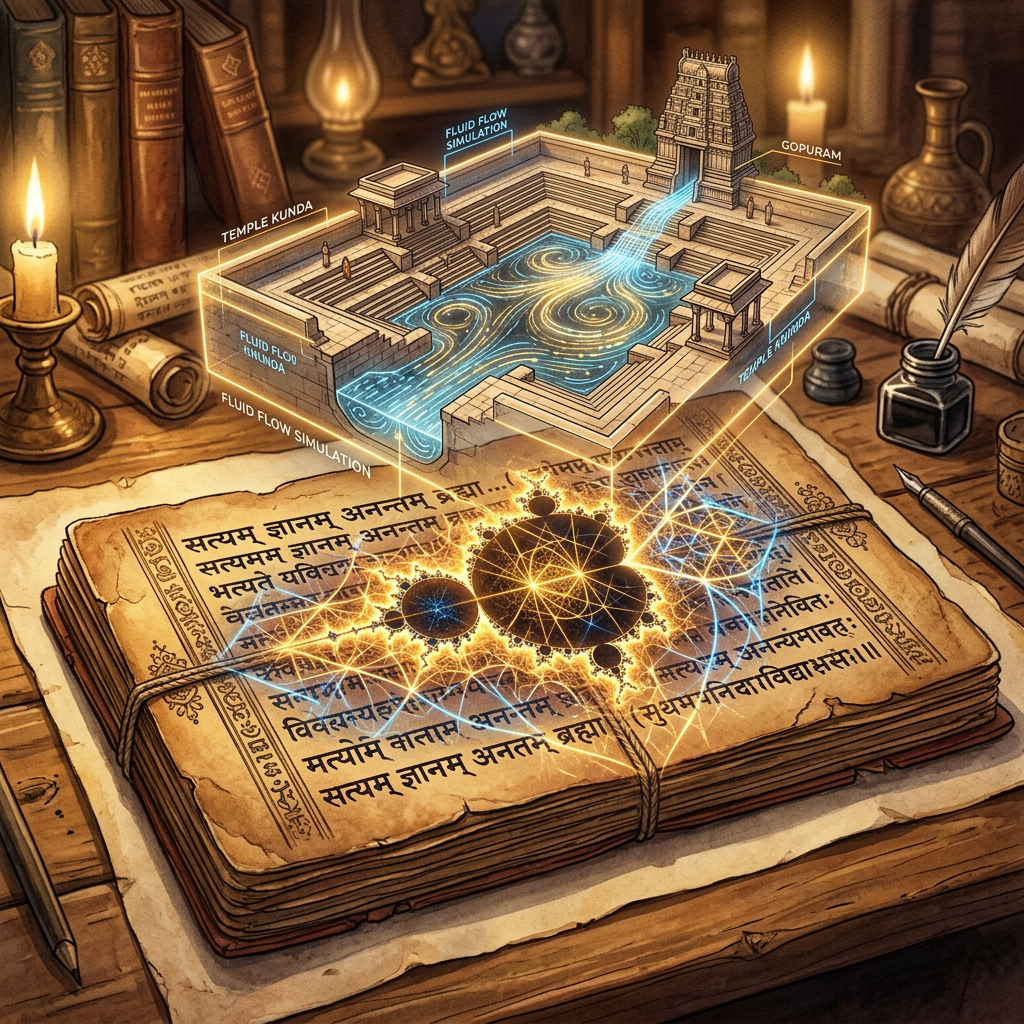
A breakthrough study published in the Journal of Archaeological Science has identified sophisticated mathematical modeling in previously unstudied 12th-century Sanskrit manuscripts from the Bijaganita-Kautuka tradition. Using advanced computational analysis, researchers demonstrated that these texts contain recursive algorithms designed to predict non-linear fluid oscillations within temple reservoir systems. These findings suggest that medieval Indian mathematicians possessed a rigorous understanding of wave-phase interference and hydrodynamic stability centuries before similar principles were formalized in European physics.
The research team utilized high-resolution multispectral imaging to reconstruct the fragmented palm-leaf manuscripts found in a private library in Ujjain. The study reveals that the algorithms were not merely theoretical but were likely employed in the structural design of large-scale irrigation tanks to mitigate the effects of seasonal surges. This integration of algebraic logic with hydraulic engineering underscores the advanced state of empirical science in the post-Vedic period.