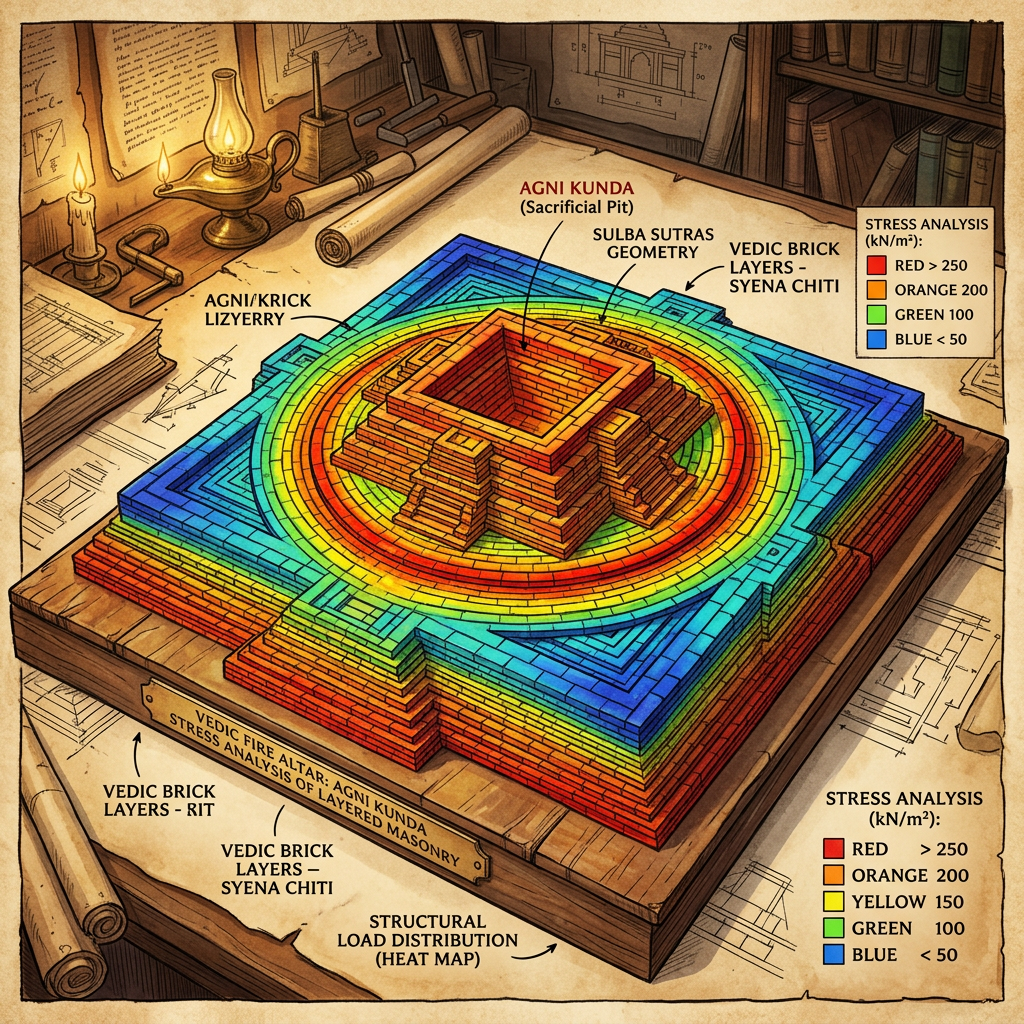
New research published in the Journal of Ancient Mathematical Sciences has unveiled a complex system of recursive algorithmic modeling within the 1st millennium BCE Baudhayana Sulba Sutras. The study demonstrates that the geometric instructions for constructing large ritual platforms included implicit calculations for stress distribution, ensuring that the vaulted brick structures could support massive weights without structural failure.
By applying modern finite element analysis to the ancient Vedic formulas, scholars found that the brick-layering patterns followed a fractal-like progression that naturally dispersed mechanical load. This study refines our understanding of ancient Indian science, proving that early Vedic architects possessed a sophisticated grasp of structural mechanics and material physics long before the formalization of civil engineering.