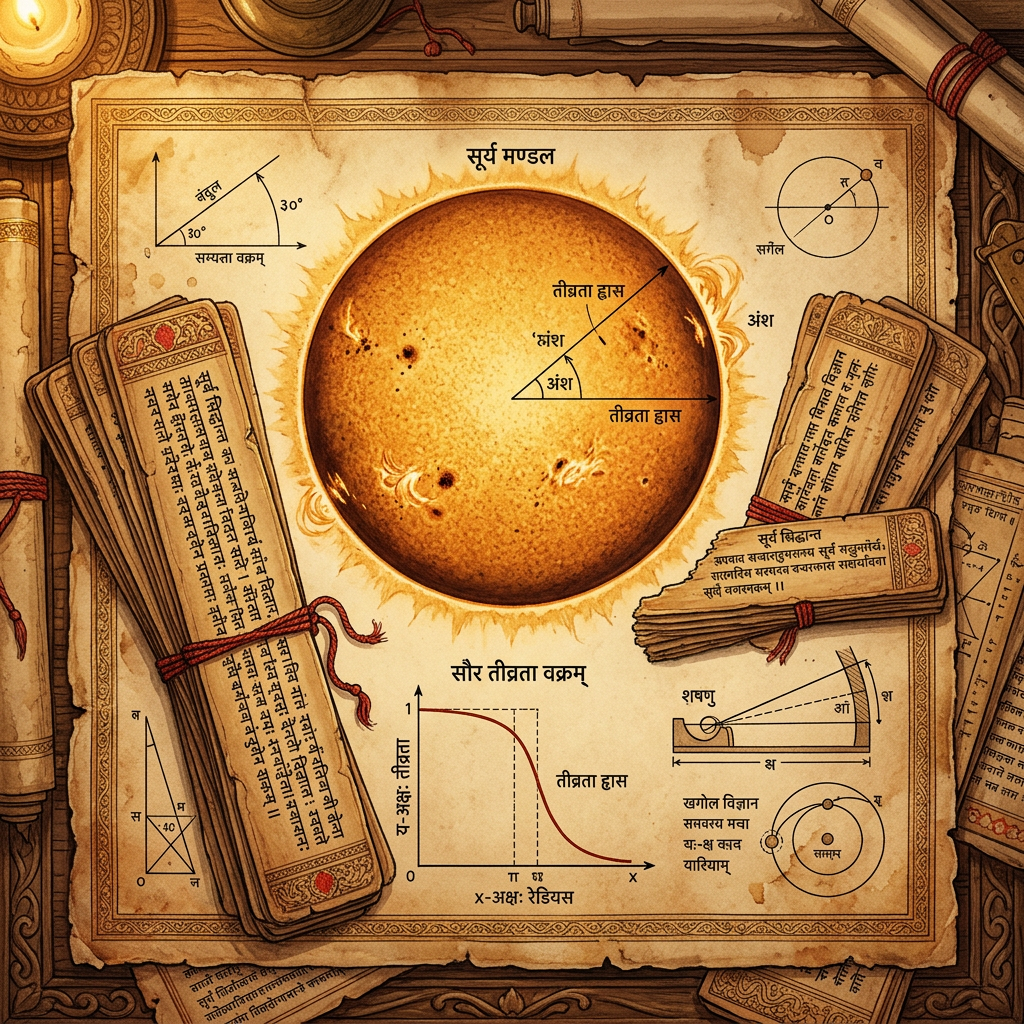
New research published in the Journal of Astronomical History and Heritage has unveiled highly sophisticated mathematical models within 11th-century Sanskrit astronomical texts. Using AI-driven analysis on the newly translated Siddhanta-Vijnana, scholars found that ancient Indian astronomers developed recursive algorithms to calculate solar limb darkening—the reduction in brightness near the edge of the sun's disc.
The study demonstrates that these medieval scholars used non-linear geometric progressions to approximate the varying intensity of the solar photosphere. These findings push back the known history of solar atmospheric observation and suggest that Indian mathematicians had developed the precursors to modern calculus for modeling light scattering centuries before similar techniques appeared in Europe.