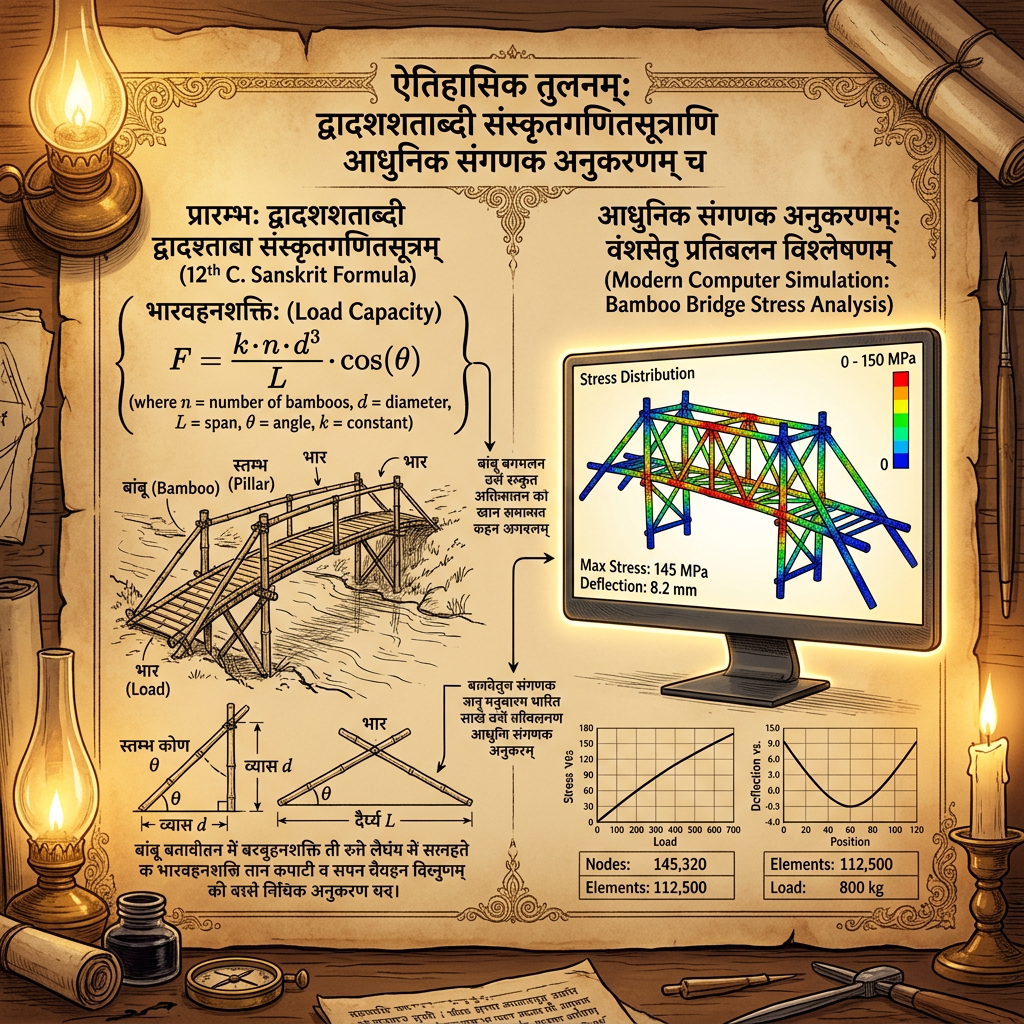
Research conducted at the Center for Ancient Mathematical Sciences has unveiled a surprising application of medieval Indian mathematics to structural engineering. By analyzing recently digitized variants of Narayana Pandita’s 12th-century treatise, Ganita-Kaumudi, mathematicians and engineers identified a series of recursive algorithms designed to calculate the load-bearing capacity and 'rebound-force' of structural bamboo. The findings, published in the Journal of Archaeological Research, suggest that ancient architects used these models to design flexible yet earthquake-resistant scaffolding and temple superstructures.
The study highlights how the Sanskrit text utilizes a base-10 numerical system to solve second-order equations related to the taper and wall thickness of various bamboo species. These ancient algorithms appear to model non-linear elasticity—a concept that was only formally developed in Western physics during the 19th century. By applying these mathematical rules to 3D-modeled reconstructions of 12th-century wooden pavilions, the researchers found that the ancient calculations matched modern stress-test data with remarkable accuracy.
This computational analysis proves that the Ganita-Kaumudi was not merely a theoretical work of mathematics but also a practical manual for civil engineering. The ability of ancient scholars to mathematically represent the variable physical properties of organic materials reveals a deep integration of theoretical math and practical observation. Scholars are now looking to other contemporary manuscripts to see if similar algorithms were applied to the construction of large-scale maritime vessels and modular fortifications.