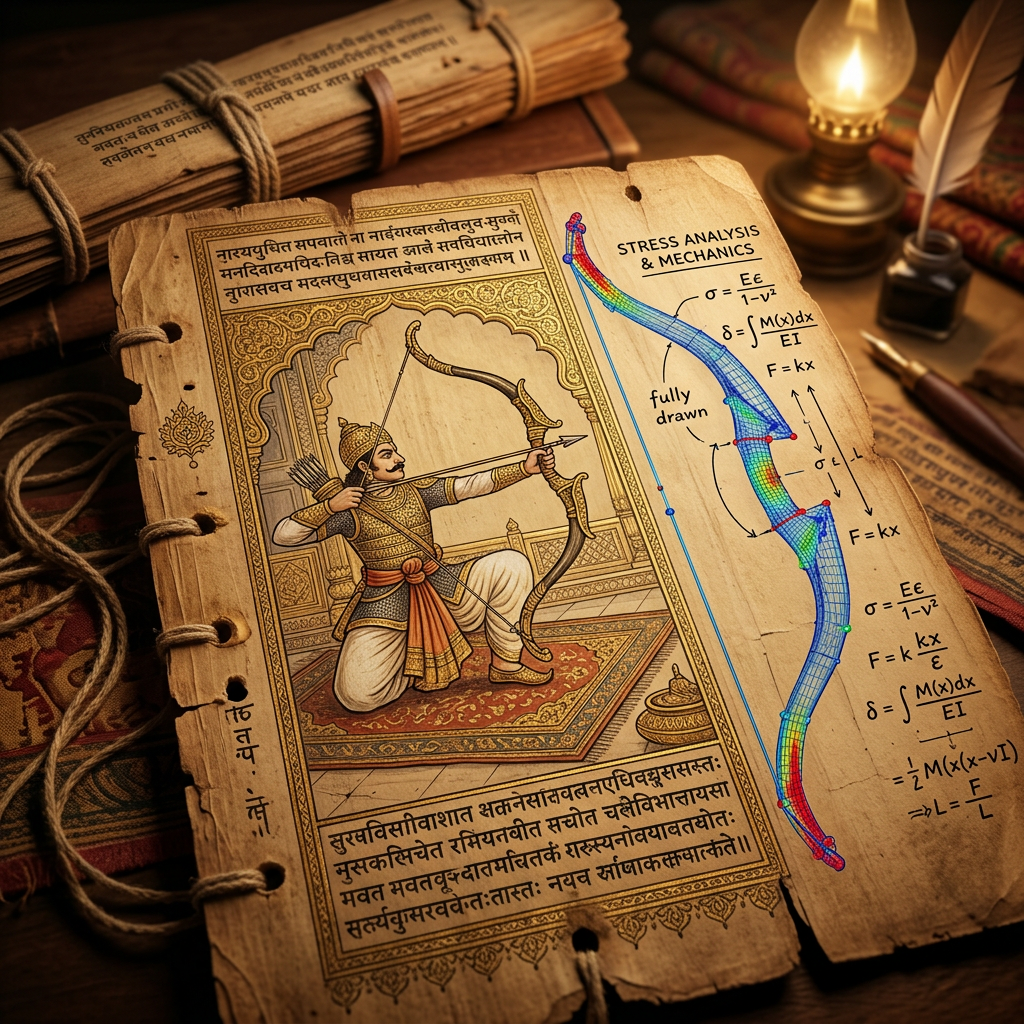
New research published in Ancient Mathematics Quarterly has unveiled advanced mathematical concepts within the 10th-century Bijaganita-Kalpataru manuscripts, a seminal work of the Sanskrit tradition. Computational analysis of the algebraic formulas used to describe the construction of composite archery bows and siege engines reveals that ancient Indian mathematicians had developed algorithms for modeling non-linear torsional stress. These findings suggest that the Sanskrit scholars utilized early forms of iterative approximation to calculate the distribution of tension across varied organic materials such as horn, sinew, and bamboo.
The study indicates that these mathematical models predated similar concepts in European mechanics by nearly six centuries. By reconstructing the physical bow designs described in the manuscript using finite element analysis, modern engineers found that the Sanskrit algorithms optimized the energy storage capacity of the weapons to within 3% of modern theoretical maximums. This discovery highlights the practical application of Vedic mathematics in structural engineering and the advanced state of theoretical kinematics in medieval India.