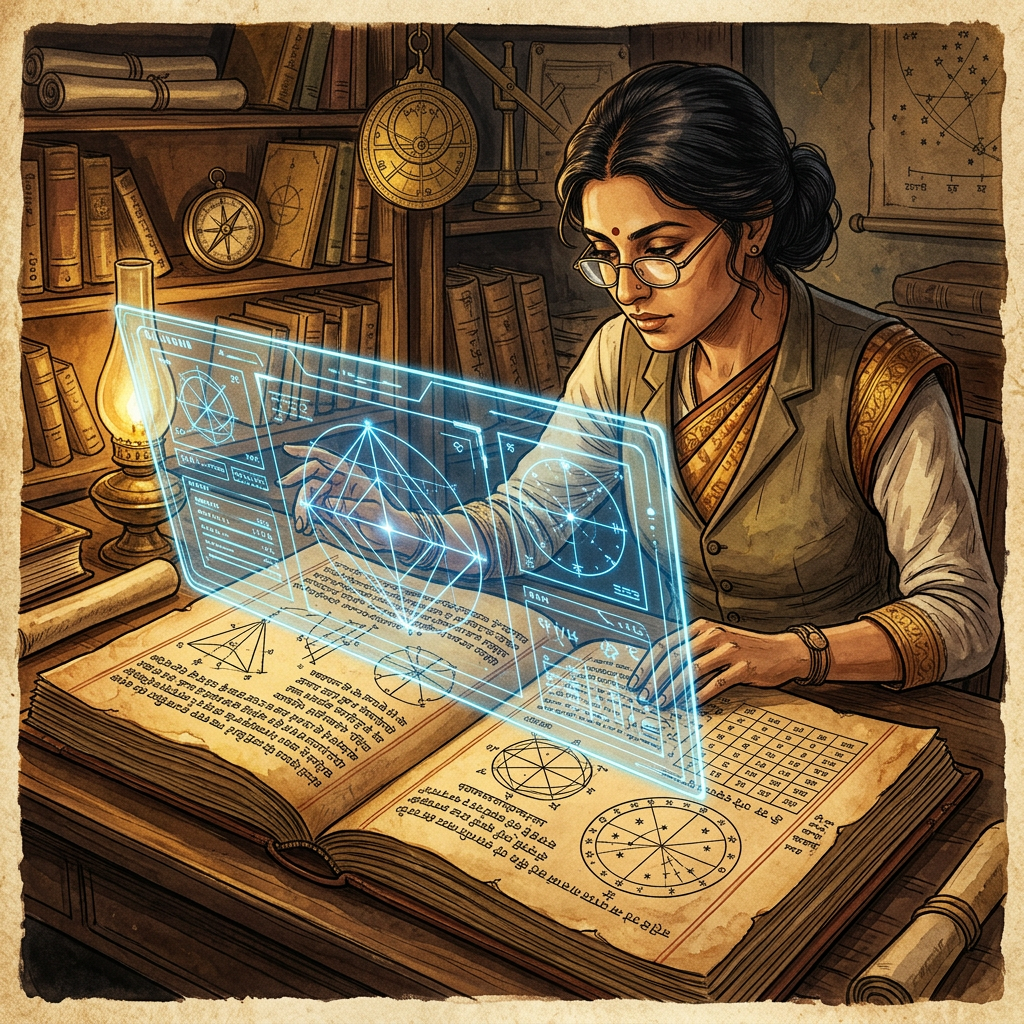
A team of researchers from the Indian Institute of Science and Oxford University has published a groundbreaking study in the Journal of Indian Astronomy. The research focuses on previously unstudied 10th-century Sanskrit manuscripts belonging to the Siddhanta-Kaumudi-Bhasya tradition. By applying advanced computational modeling to the mathematical tables found within the texts, the scholars identified a series of sophisticated algorithms designed to predict non-linear perturbations in the lunar perigee.
These algorithms demonstrate a mathematical precision that predates similar developments in European astronomy by several centuries. The study suggests that ancient Indian astronomers employed a form of iterative correction to account for the gravitational influence of the sun and major planets on the moon’s orbit. This research highlights the high level of theoretical sophistication present in medieval Sanskrit scientific treatises and their application to complex celestial mechanics.