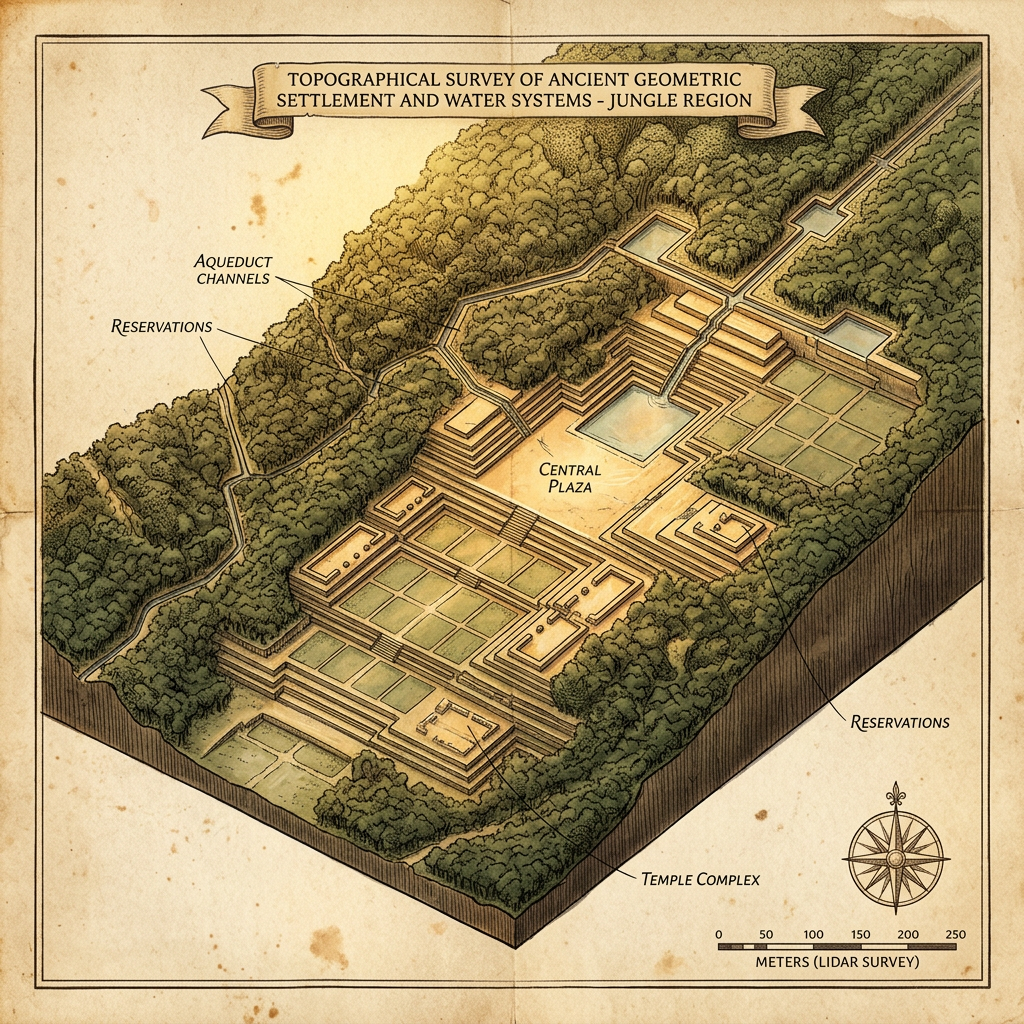
A large-scale LiDAR survey in the Petén Basin of Guatemala has identified a massive 9th-century urban network described as a 'Vertical Hydro-Acoustic Navigation Grid.' The mapping reveals a series of interconnected reservoirs and tiered sluice gates that were engineered not only for water storage but for creating specific acoustic signals. These 'sound-beacons' would have allowed Maya travelers to navigate the dense jungle by following the distinct resonant frequencies produced by the falling water.
The survey suggests that the system integrated specialized stone resonance-chambers at key junctions, which amplified the sound of the water to be heard over several kilometers. This unprecedented find indicates a level of acoustic engineering previously unknown in Mesoamerica, where the environment itself was manipulated to serve as a massive, audible navigational map for the city's inhabitants.