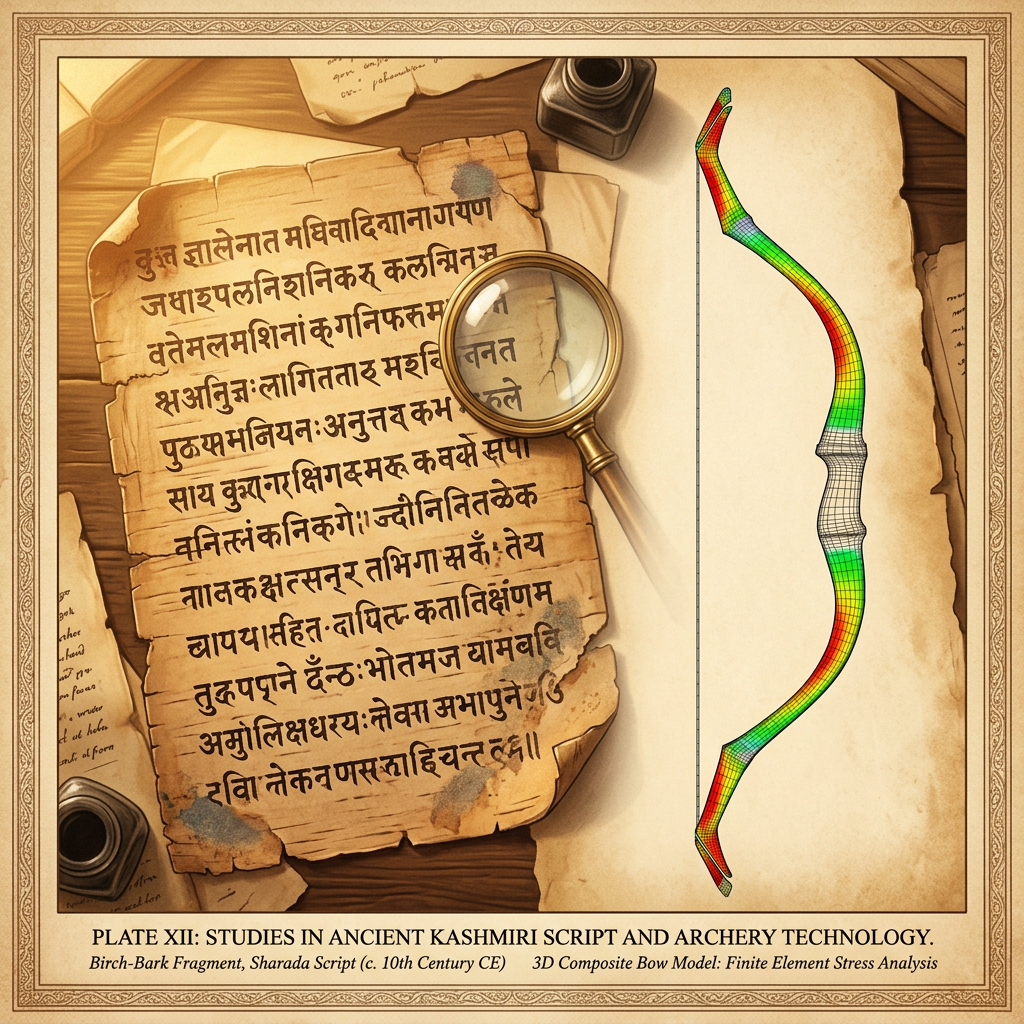
A consortium of researchers from the Global Manuscript Institute has utilized a new neural-mapping algorithm to decipher 8th-century Sharada script fragments discovered in a high-altitude Himalayan cave. The texts reveal a lost Sanskrit treatise detailing the physics of elastic potential energy and the stress-strain relationships in multi-layered composite longbows. The manuscript provides detailed calculations for the Young's modulus of various organic materials, including horn, sinew, and specialized bamboo.
The findings indicate that ancient Indian engineers possessed a theoretical understanding of material science and mechanical advantage that was used to optimize the ballistic properties of military hardware. The treatise includes early mathematical proofs for the energy-storage capacity of curved structures, suggesting a bridge between late-Vedic geometry and practical mechanical engineering in the early medieval period.