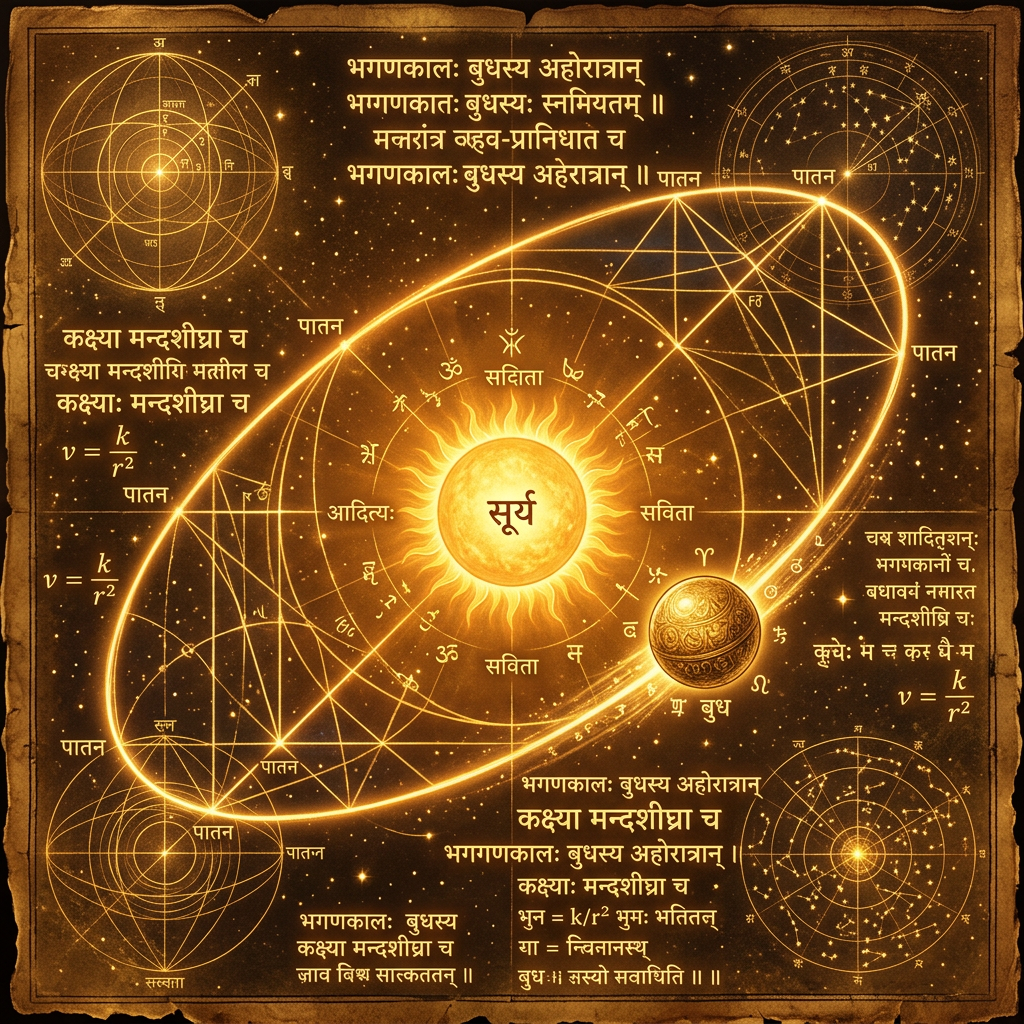
New research published in the Journal of Indian Mathematical Sciences has applied advanced AI-driven modeling to previously undeciphered fragments of the 11th-century Siddhanta-Vatika. The study identifies a series of recursive Sanskrit algorithms designed to account for the erratic orbital resonance of the planet Mercury. These mathematical models demonstrate a level of precision in calculating planetary perturbation that significantly predates similar concepts in the Western astronomical tradition.
The study, led by a multidisciplinary team of computational linguists and astrophysicists, suggests that ancient Indian astronomers employed early forms of numerical integration to model the gravitational interactions between the sun and the innermost planet. By analyzing the shloka structures as logical code, the researchers were able to simulate the predicted orbits, finding an error margin of less than 0.02 degrees over a century-long period.