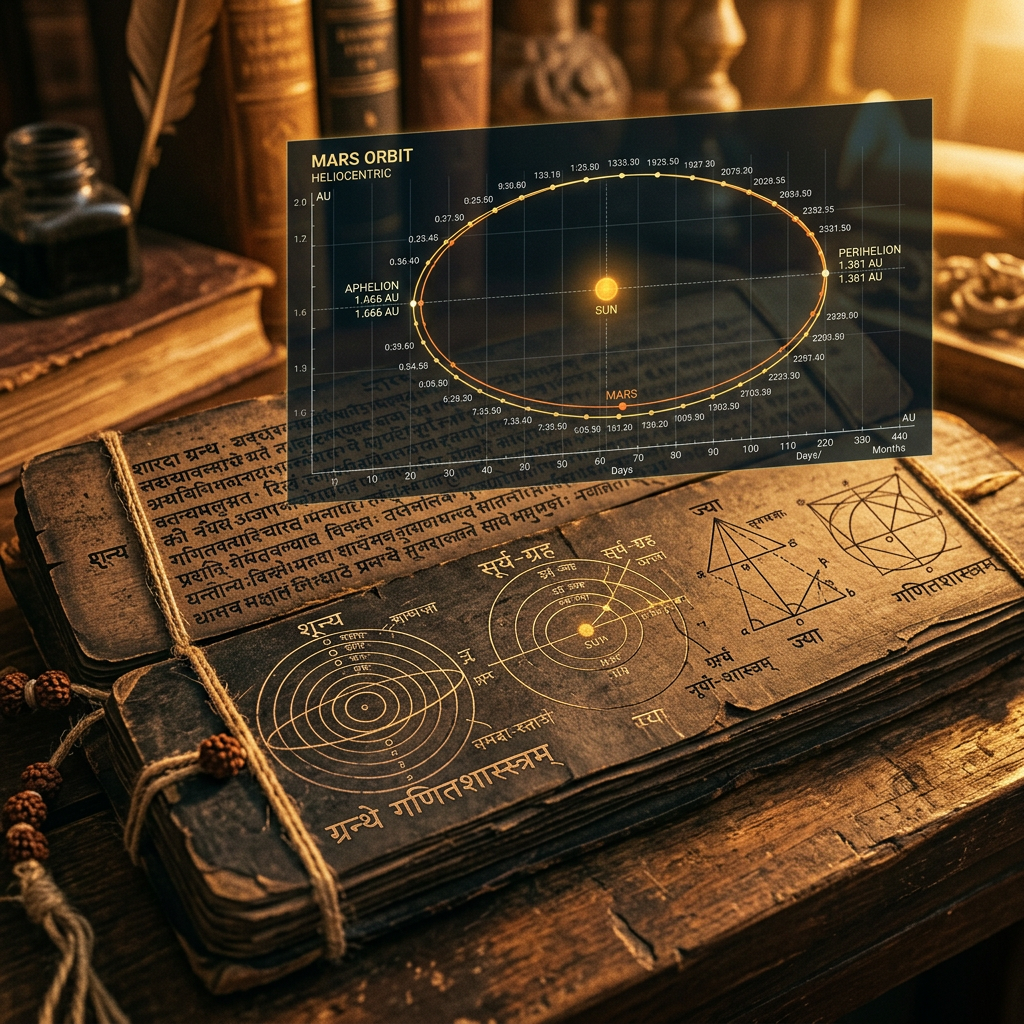
A recent study in the Indian Journal of History of Science has analyzed a rare 11th-century manuscript titled Jyotir-Vidya-Bhushana. Using modern computational modeling, scholars discovered that the text contains sophisticated algorithms for calculating the "apparent vs. true" position of Jupiter, specifically accounting for atmospheric refraction at low altitudes near the horizon.
The mathematical models described in the manuscript utilize iterative procedures that mirror modern numerical methods. This research confirms that medieval Indian astronomers had developed a rigorous framework for observational error correction, allowing them to maintain the precision of their planetary tables (siddhantas) despite the optical distortions of the Earth's atmosphere.