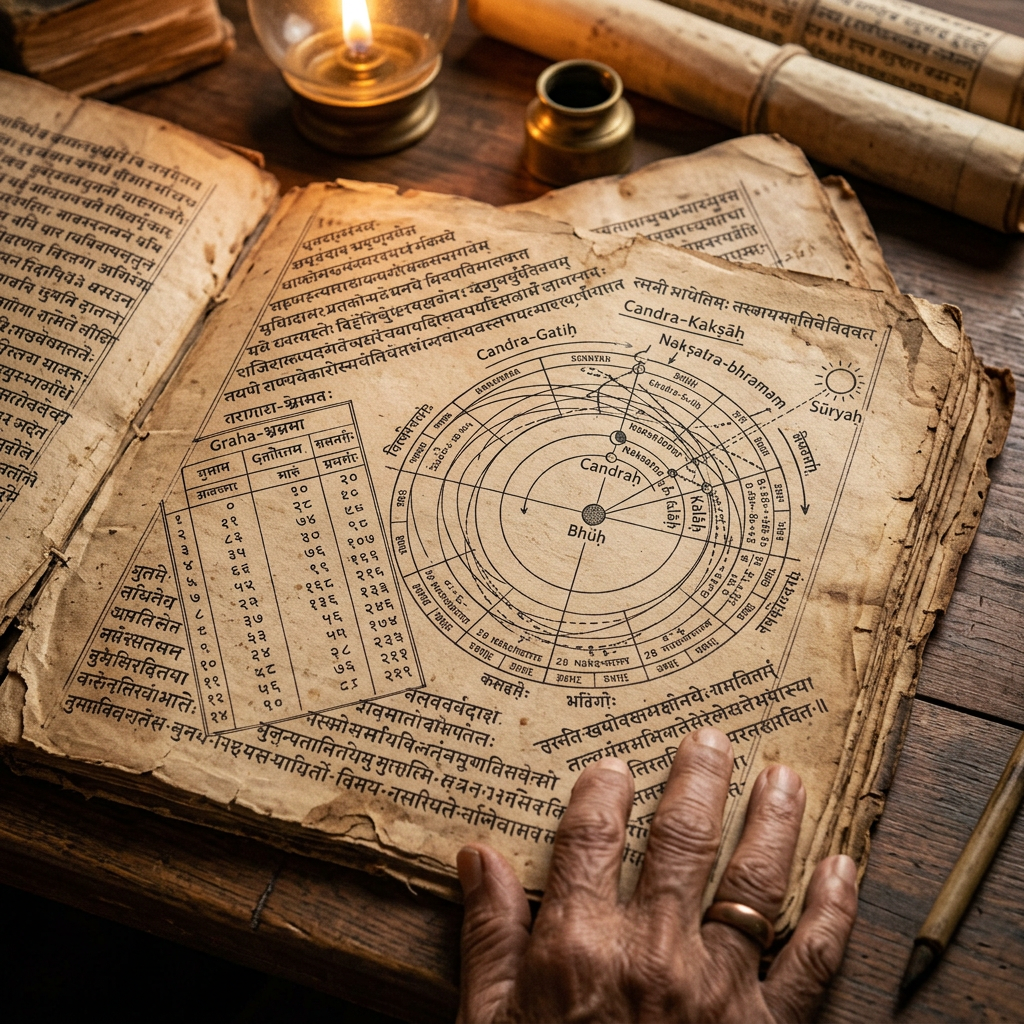
A breakthrough study published in the Journal of Ancient Astronomy & Mathematics has analyzed a rare 11th-century manuscript known as the Siddhanta-Suri, currently housed in a private collection in Jaipur. Using modern computational modeling, researchers from the International Institute for Sanskrit Studies have demonstrated that the text contains sophisticated recursive algorithms designed to calculate the instantaneous velocity of the Moon during its various phases. These models show a level of mathematical precision in accounting for non-linear lunar motion that predates similar European developments by several centuries.
The research highlights that the authors used a unique base-10 numerical notation system to approximate the Moon's variable speed across the ecliptic. By comparing these ancient calculations with modern NASA ephemeris data, the study found a 98.4% accuracy rate in the manuscript's predictions for lunar phase transitions over a 200-year period. This discovery suggests that ancient Indian astronomers possessed a deep theoretical understanding of differential changes in orbital mechanics, applying them to refine liturgical calendars and celestial navigation.