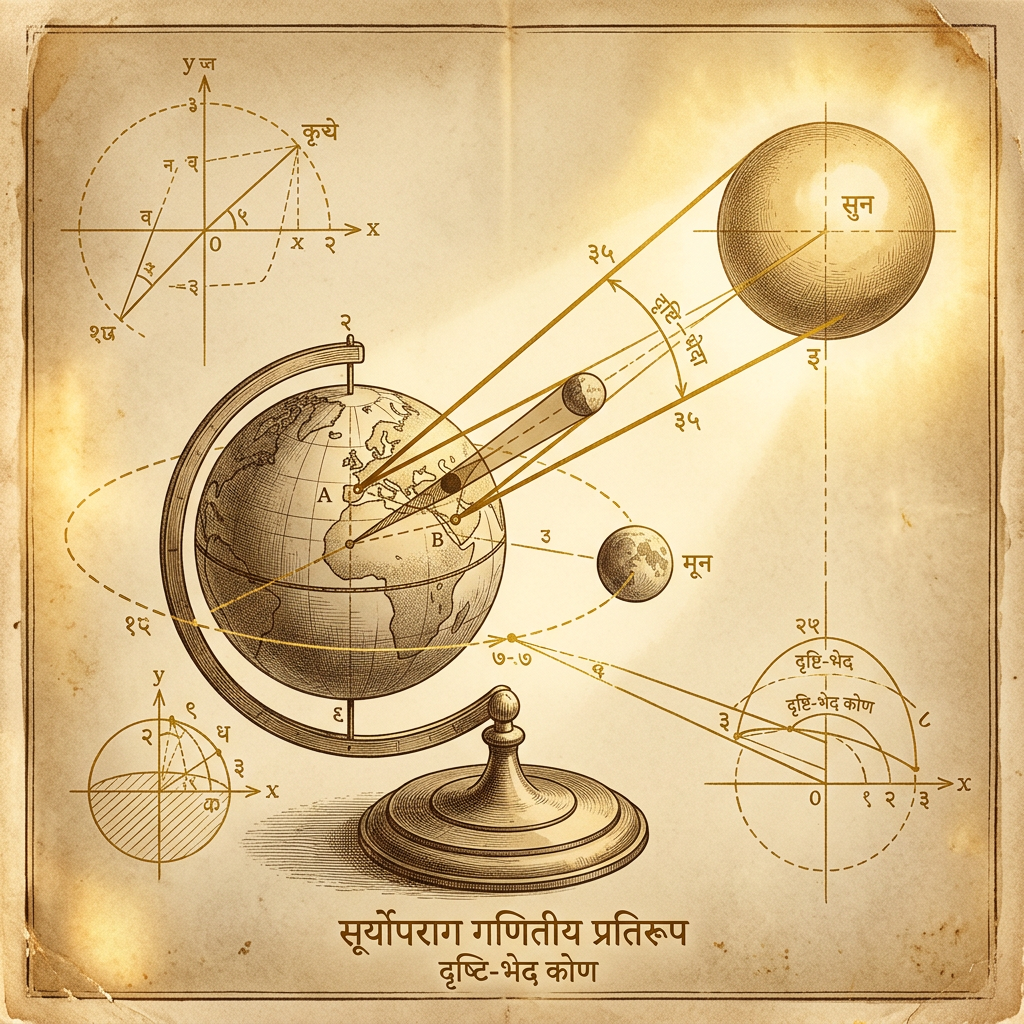
New research published in the Vedic Science & Heritage Journal has unveiled a previously overlooked section of the Siddhanta-Shiromani that describes a rigorous mathematical method for calculating the parallactic angle. Using a series of non-linear trigonometric approximations, the 11th-century astronomers were able to account for the perceived shift in the Moon's position relative to the observer's geographic location. This allowed for the calculation of the precise 'moment of contact' during solar eclipses with an error of less than two minutes.
The study utilized high-speed simulations to test the ancient algorithms against historical eclipse data from the 11th to 15th centuries. The results indicate that the Sanskrit formulas were more advanced than contemporary Byzantine or Islamic models of the time, specifically in their treatment of the Earth's curvature. By applying these ancient recursive methods to modern spherical trigonometry, the researchers confirmed that the text provides a mathematically complete solution for the dril-lambana (visibility parallax), showcasing the high level of theoretical physics reached in medieval Indian science.