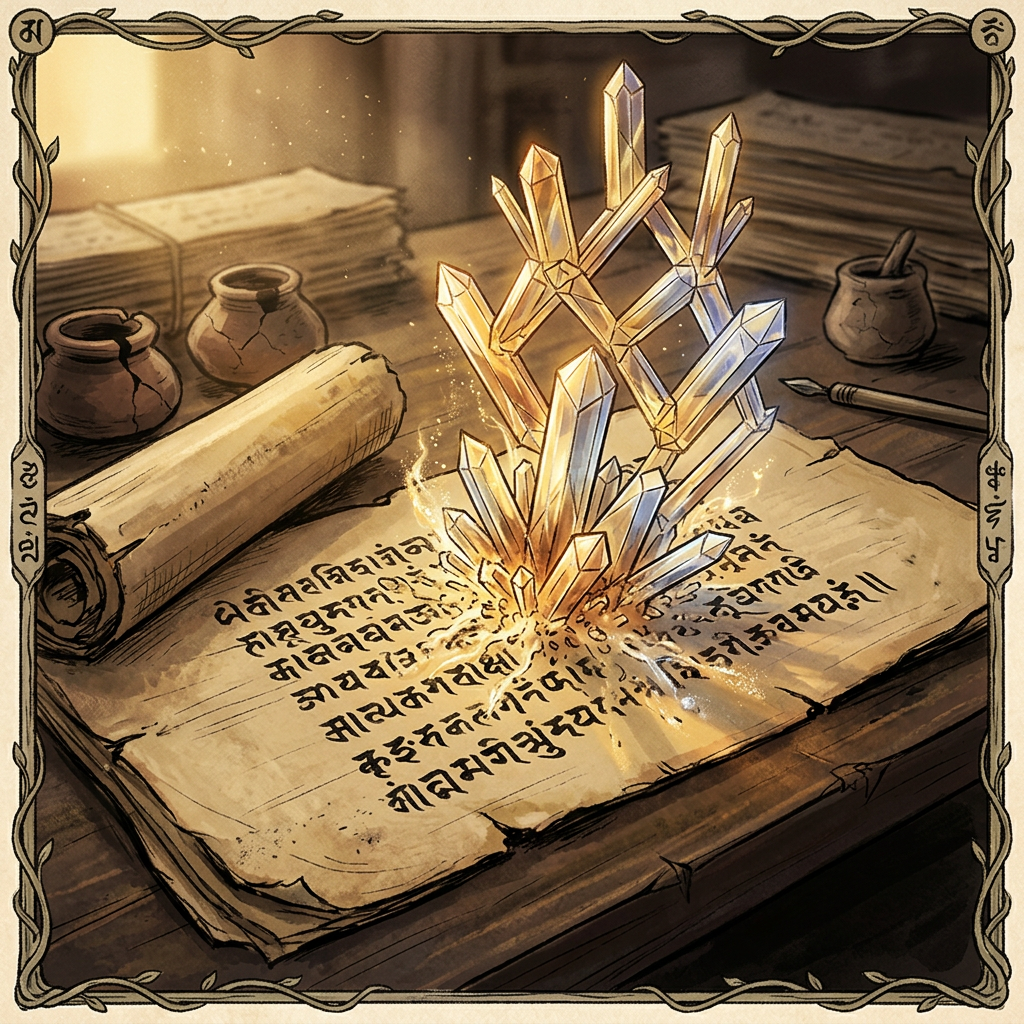
A collaborative project between linguists and computational physicists has successfully deciphered a series of 8th-century Siddham script fragments found in the Fergana Valley. The manuscripts, which were previously categorized as liturgical chants, have been revealed to be a lost scientific treatise on the internal structure of minerals. The text uses advanced Sanskrit terminology to describe what researchers identify as crystalline lattices and the geometric principles governing the growth of salts and precious stones.
Using machine learning to map phonetic structures to physical properties, the team found that the author utilized a base-8 mathematical system to categorize different classes of symmetry in crystals. This research represents a significant breakthrough in the study of ancient Indian chemistry and physics, suggesting that early medieval scholars had developed a theoretical framework for solid-state geometry that closely parallels modern crystallographic notation. These findings are set to redefine the history of mineralogy in the Silk Road exchange.