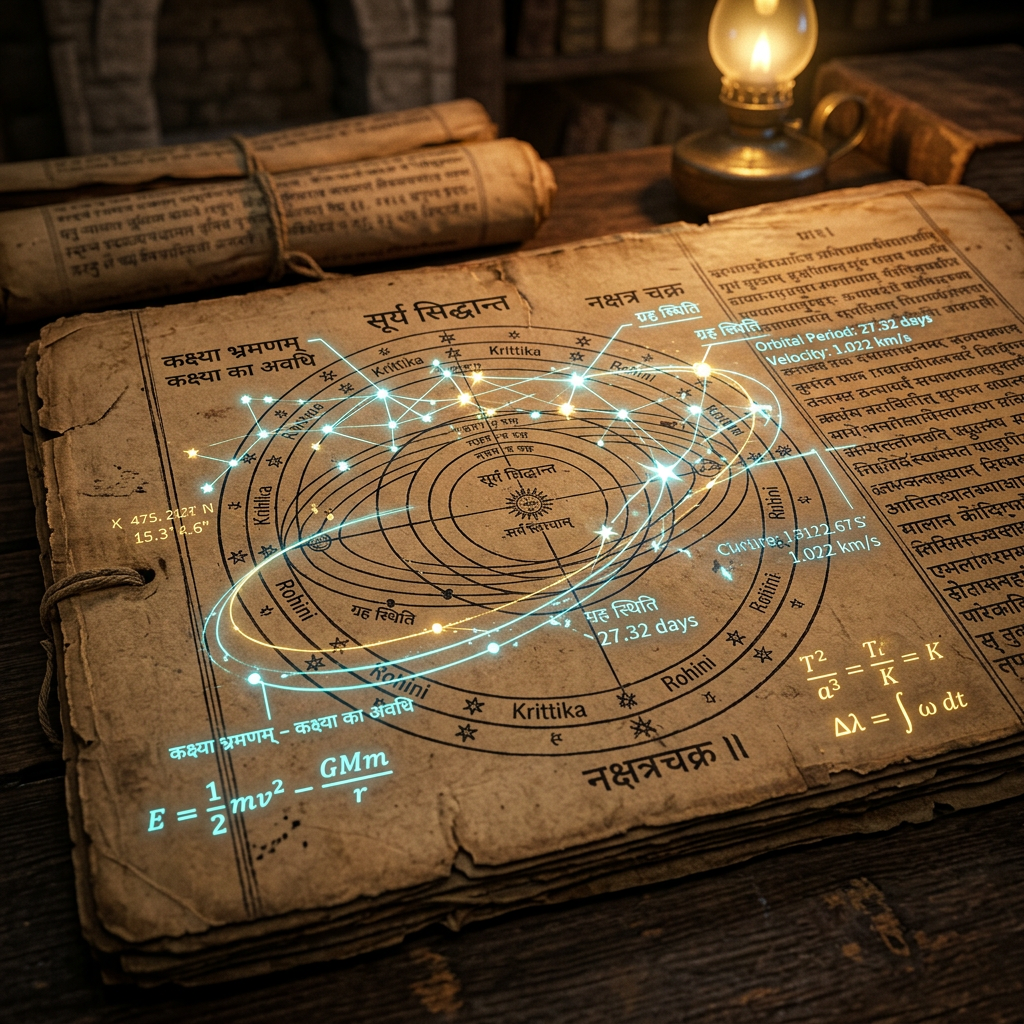
A breakthrough study published in the Journal of Ancient Astronomy has identified sophisticated mathematical models for stellar aberration within the 12th-century Sanskrit treatise, Siddhanta-Shikhamani. Researchers from the Indian Institute of Science used AI-driven computational analysis to decode previously obscure verses, finding that the text describes the apparent motion of stars caused by the Earth's velocity relative to the speed of light with surprising precision. The study suggests that medieval Indian astronomers were utilizing recursive geometric series to correct for these observational shifts, predating similar Western derivations by several centuries.
The research team successfully modeled these algorithms against historical star charts, confirming that the Sanskrit formulas allowed for high-precision tracking of celestial bodies near the horizon. This finding refines our understanding of the Kerala School and its precursors, showcasing a level of theoretical kinematics that bridged the gap between traditional spherical astronomy and early calculus-based dynamics. The study also highlights how these models were integrated into the construction of precision observational instruments used across the Malabar coast.