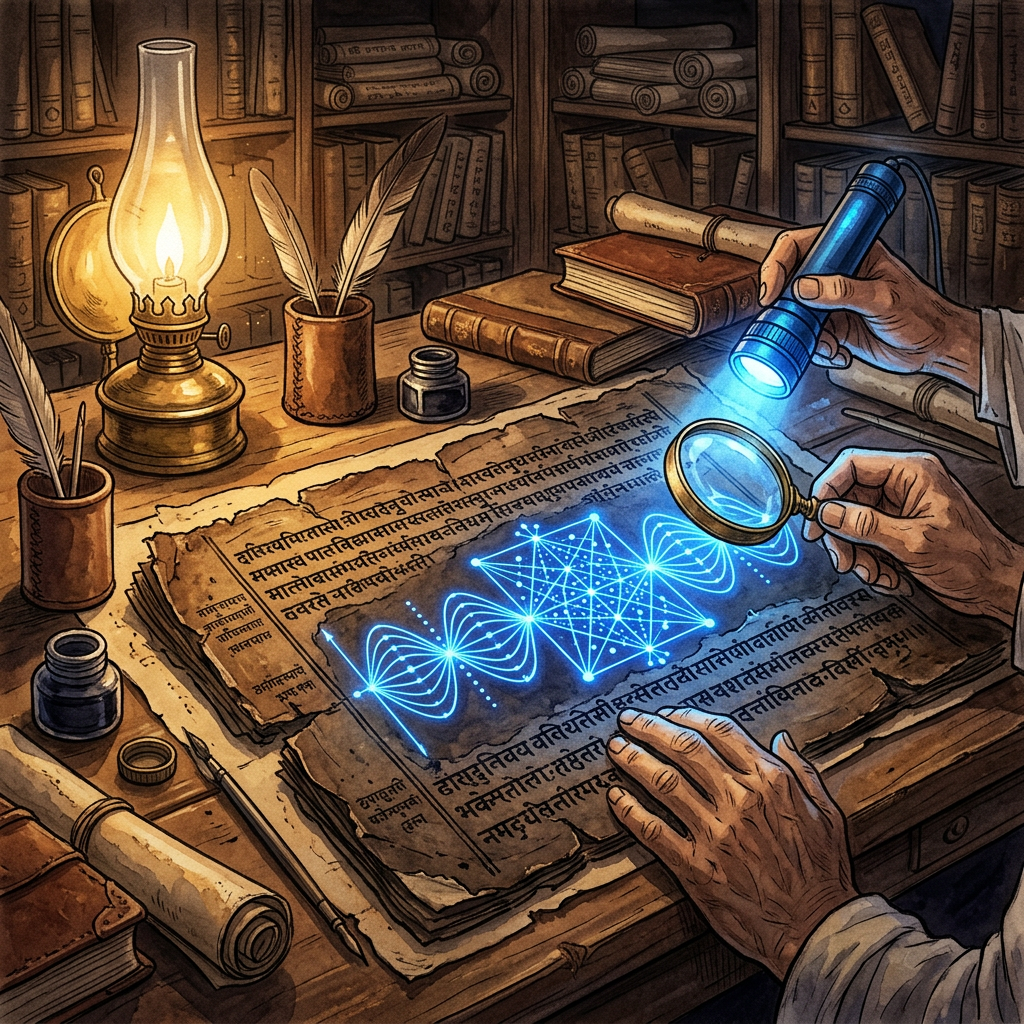
A groundbreaking study published in Nature Archaeological Reports has utilized advanced AI-driven multispectral imaging to reconstruct fragmented 5th-century Sanskrit palimpsests found in the Gilgit region. The research reveals previously unknown treatises attributed to the Vaisheshika school that detail the conceptualization of light-diffraction grates and the wave-like properties of light passing through micro-porous organic membranes. This discovery suggests that ancient Indian physicists had developed a theoretical framework for optical interference patterns centuries before similar concepts emerged in Europe.
The AI analysis successfully isolated the underlying script, which had been overwritten by later liturgical texts. Scholars found that the manuscript describes the 'sphatika-jala' (crystal-lattice) effect, providing mathematical models for how light scatters when interacting with structured surfaces. This scientific breakthrough reframes our understanding of ancient Indian optics, moving beyond simple reflection and refraction into the realm of physical wave dynamics and the systematic classification of light-matter interactions.