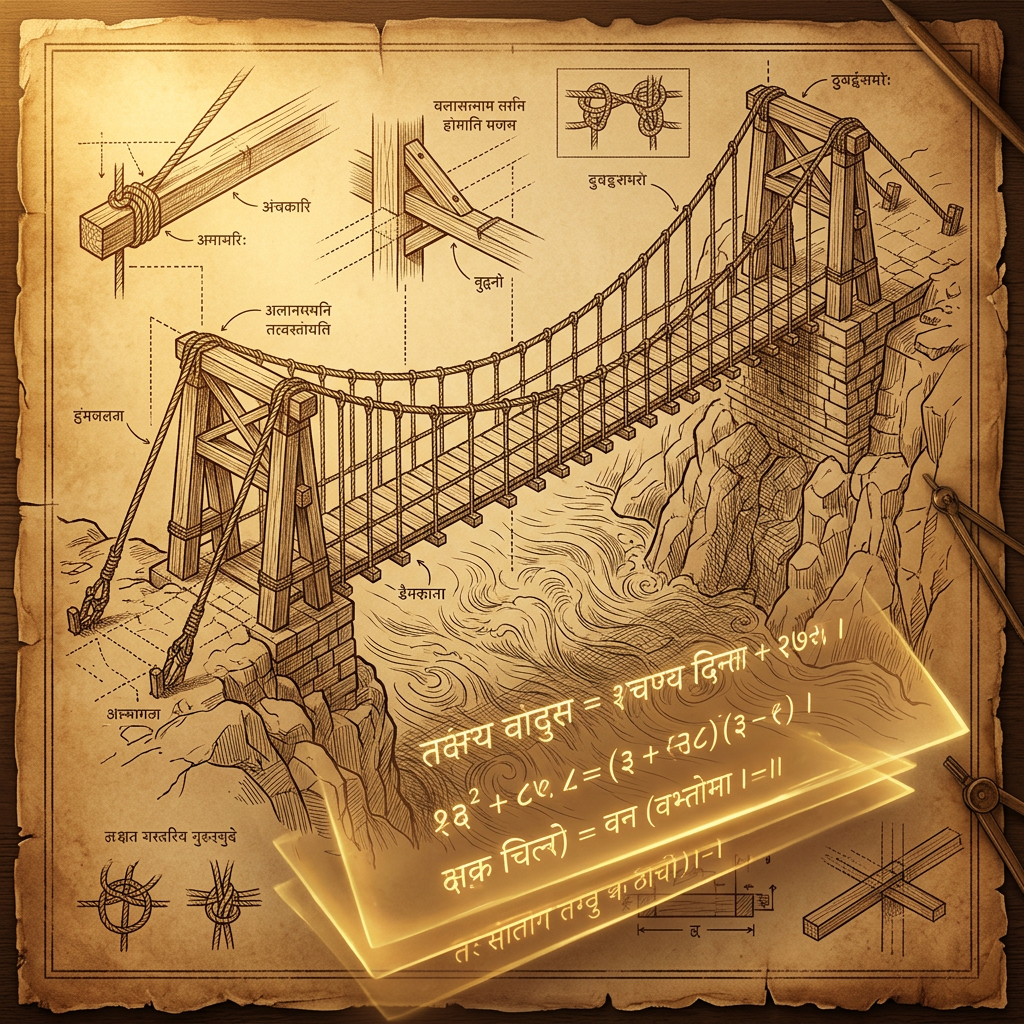
Digital paleographers in Pune have announced the decipherment of a previously unrecorded 10th-century Sanskrit manuscript titled Bijaganita-Navaratna. The text contains advanced mathematical models for calculating the structural resonance and torsional oscillation of large-scale wooden infrastructure. Specifically, it outlines algorithms for predicting the swaying motions of suspension-style river bridges under variable wind loads.
The manuscript employs recursive series to solve for Kampa-Vigyan (oscillation science), a concept that modern mechanical engineers recognize as the fundamental frequency of a structure. This breakthrough suggests that ancient Indian civil engineers used sophisticated pre-calculus logic to ensure the stability of riverine transit routes during the monsoon surges of the medieval period.