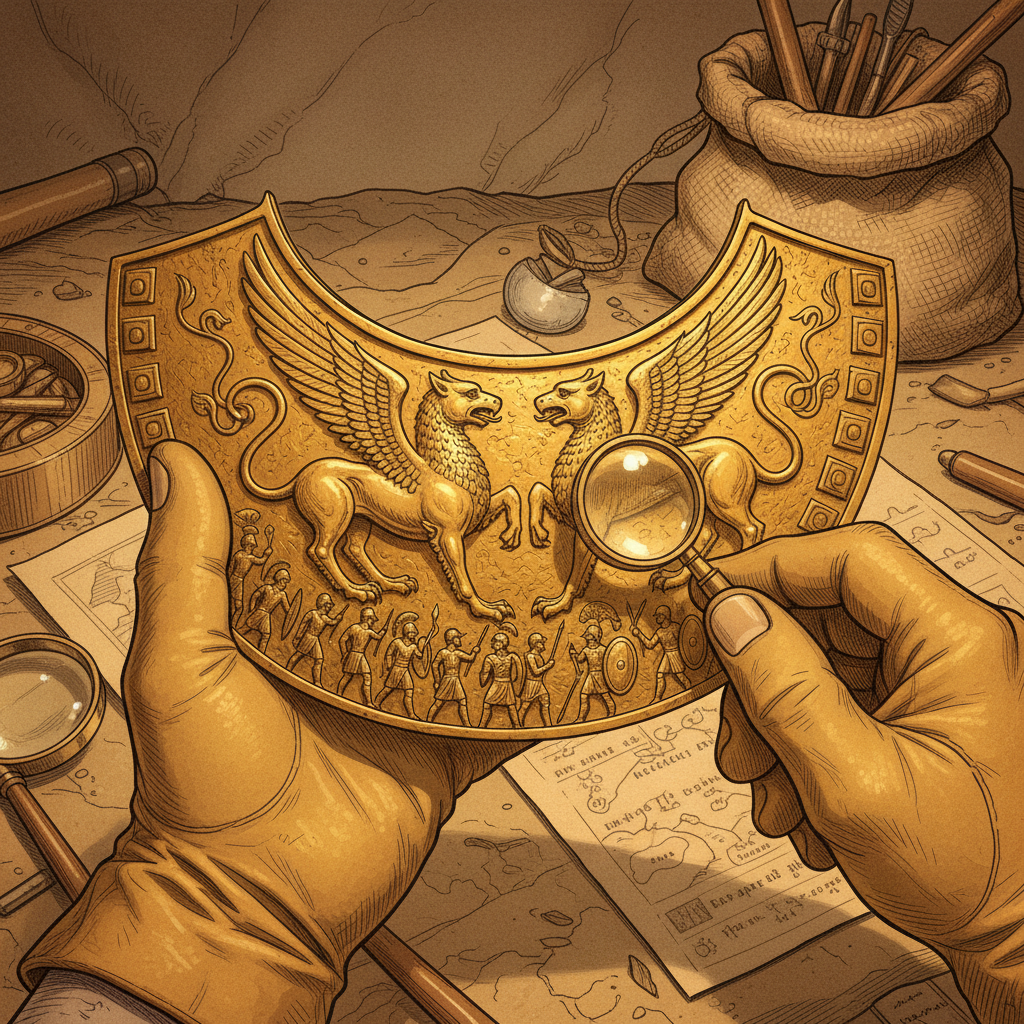
Archaeologists excavating a remote kurgan (burial mound) in the Altai Republic of Southern Siberia have discovered the unlooted tomb of a high-status Scythian woman, likely a queen or high priestess. The burial chamber, preserved by permafrost, contained a wealth of artifacts, the most spectacular of which is a solid gold breastplate featuring intricate Hellenistic friezes depicting scenes from Greek mythology intertwined with traditional nomadic animal motifs.
This artifact represents a remarkable fusion of Greek craftsmanship and Scythian iconography, suggesting direct diplomatic or commercial exchanges between the Siberian steppe and the Hellenistic colonies of the Black Sea. The 'queen' was also buried with a ceremonial mirror, silk garments of Chinese origin, and a team of six sacrificed horses adorned with gilded leather masks. The level of preservation is so high that researchers hope to perform stable isotope analysis on the queen's remains to track her migratory history across the Eurasian steppe.