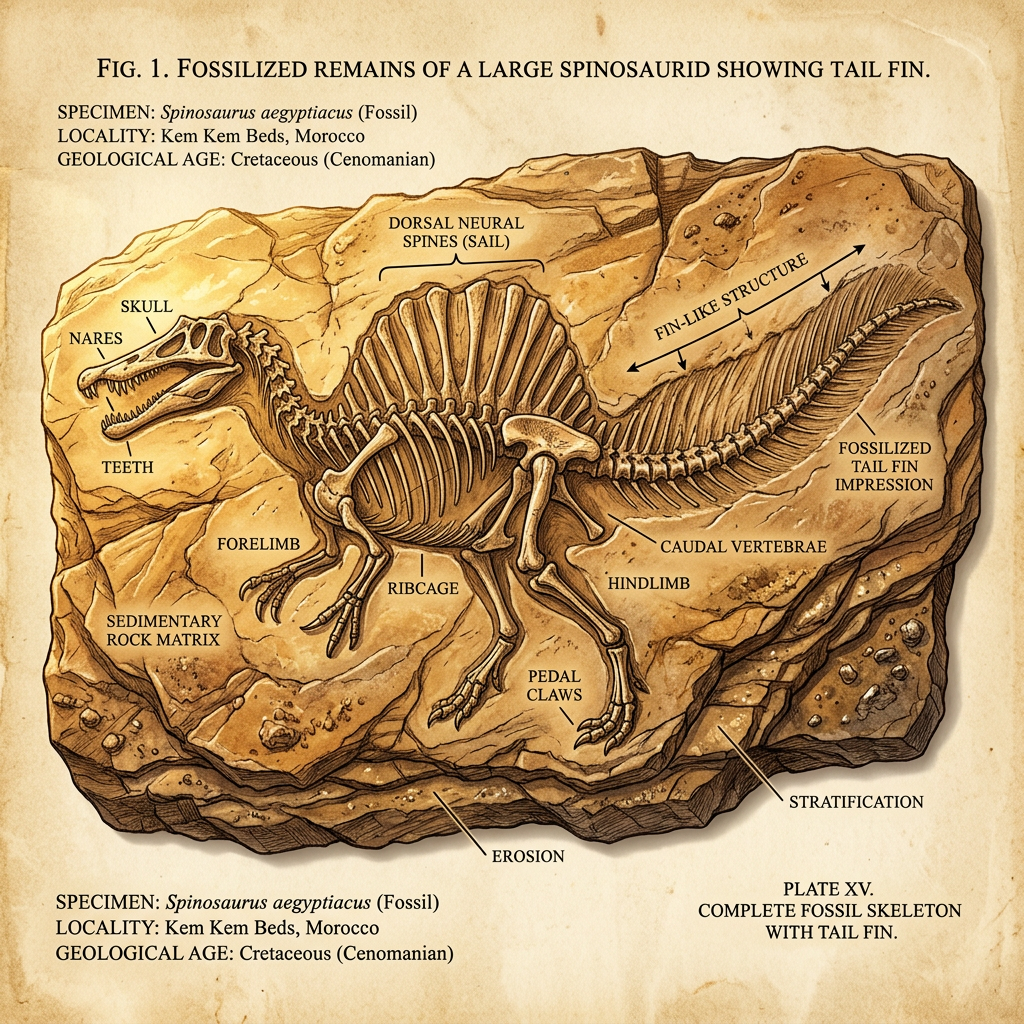
Paleontologists working in the Romualdo Formation of Brazil's Araripe Basin have unearthed a near-complete skeleton of a new spinosaurid dinosaur. The specimen is groundbreaking because it features exceptionally preserved soft-tissue impressions of a tail-fin, confirming long-held theories about the semi-aquatic lifestyle of these apex predators.
Estimated to be 10 meters long, the predator possessed a paddle-like tail and dense bones similar to those found in modern hippos, suggesting it was a highly specialized swimmer. This discovery provides the most definitive evidence yet of evolutionary transitions to aquatic life within the dinosaur lineage during the Early Cretaceous period.