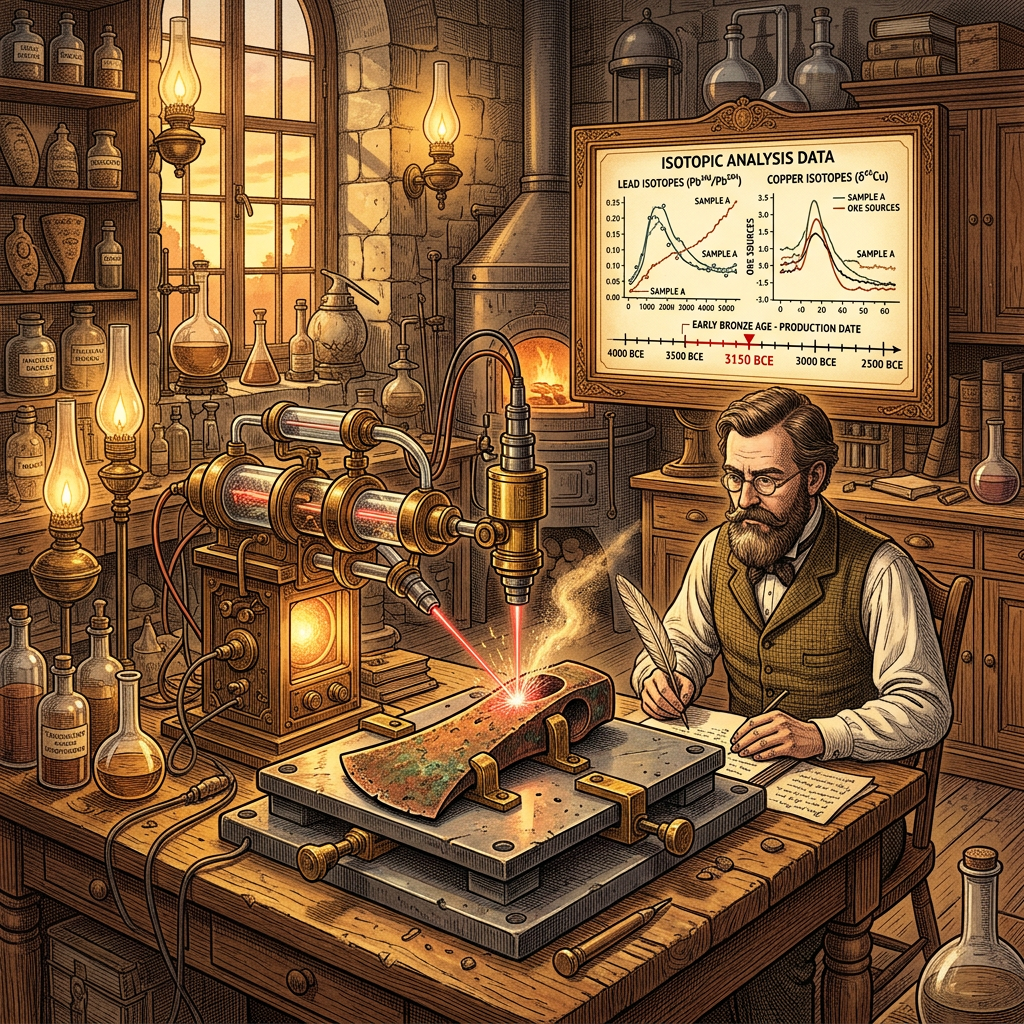
A breakthrough in archaeological dating published in the Journal of Isotopic Archaeology has provided the most precise timeline yet for the emergence of metallurgy in Central India. By applying a novel Helium-4/Argon-40 diffusion chronometry methodology to copper artifacts from the Upper Narmada Basin, scientists have pushed back the 'Copper-Hoard' culture's transition to 3150 BCE.
Traditional radiocarbon dating of associated organic remains has often yielded wide margins of error; however, this new isotopic technique measures the noble gas diffusion rates within the metal's crystalline structure itself. This allows for a sub-decadal resolution that identifies exactly when the metal was last heated to a molten state during the smelting process.
The refined dates suggest that the Neolithic-Chalcolithic transition in the Narmada Valley was a rapid, technologically-driven event that occurred much earlier than previously thought. This methodology is now being hailed as a potential 'gold standard' for dating inorganic artifacts across the Old World.