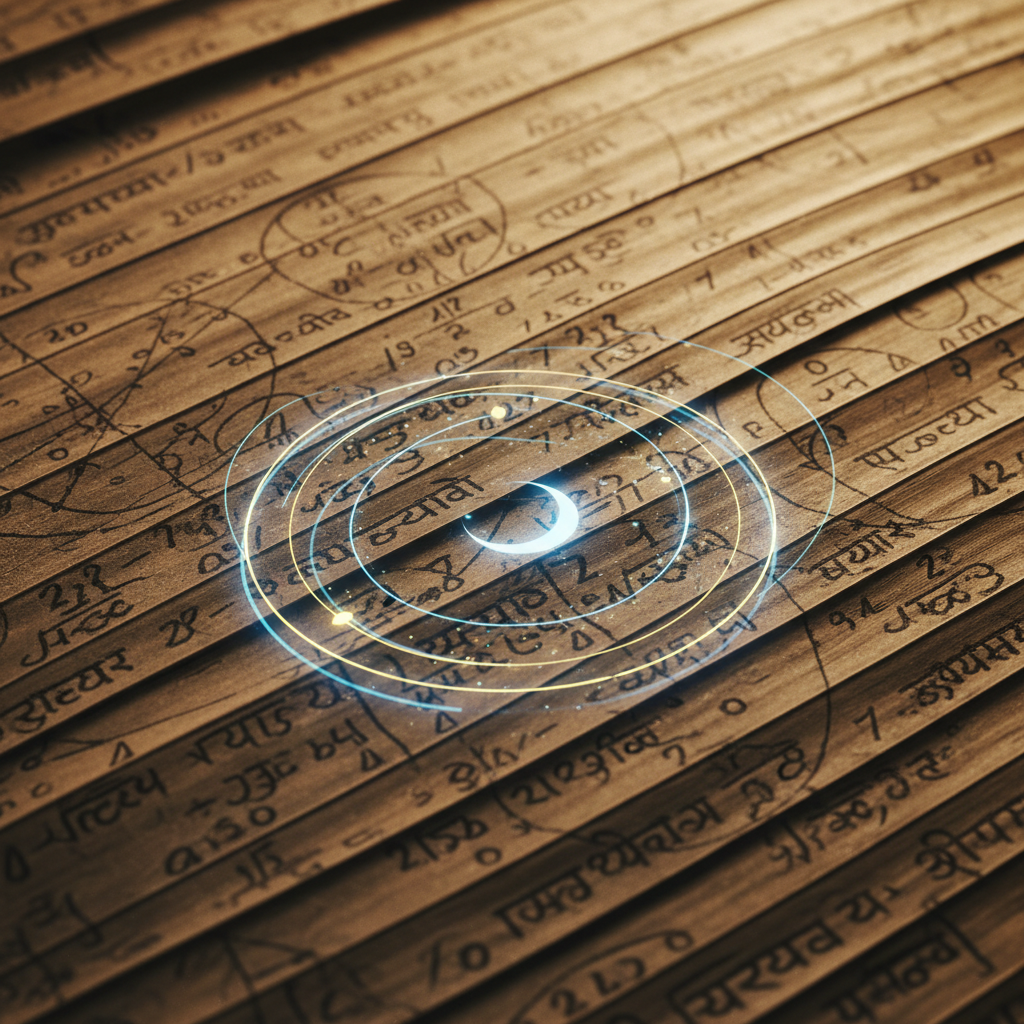
A breakthrough study published in the Archaeological Science Quarterly has revealed that 13th-century Sanskrit astronomers possessed a highly sophisticated understanding of lunar motion. By applying modern computational modeling to the Siddhanta-Sara-Dipika manuscripts found in the Mithila region, researchers identified recursive algorithms designed to calculate the subtle 'sway' or libration of the moon with a precision that rivals early European Renaissance calculations.
The research team utilized AI-driven textual analysis to parse complex mathematical verses, uncovering a framework for non-linear orbital perturbations that was previously thought to be absent from medieval Indian treatises. These findings suggest that the Mithila school of astronomy utilized advanced iterative methods to refine their planetary tables, likely to improve the accuracy of eclipse predictions and ritual calendars.
Dr. Ananya Mishra, the lead researcher, noted that the discovery of these discrete-time algorithms provides a missing link in the evolution of Indian calculus. This study emphasizes the role of the Mithila tradition as a center for high-level mathematical innovation, bridging the gap between the classical period and the later Kerala school of mathematics.