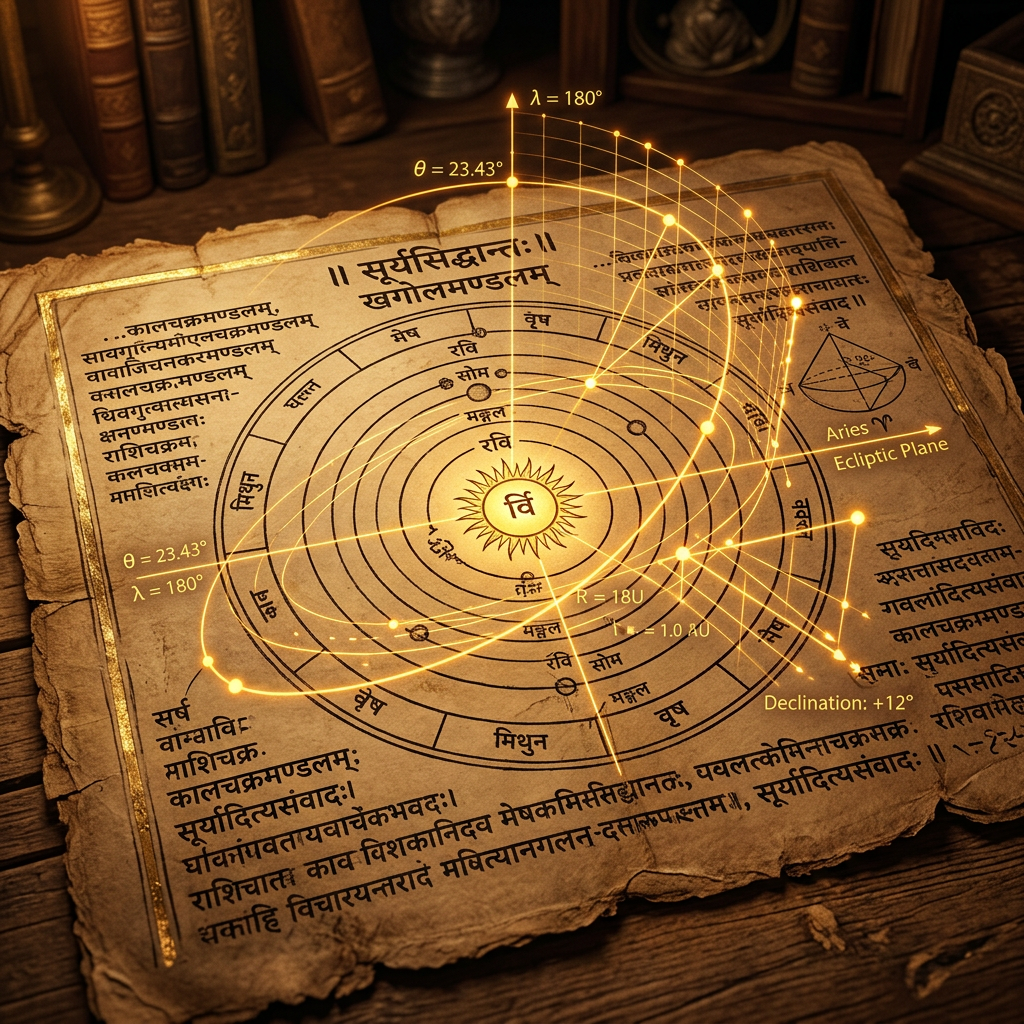
A groundbreaking study published in the Journal of Ancient Astronomy has unveiled sophisticated mathematical algorithms within the 11th-century Sanskrit manuscript Siddhanta-Vijnana-Rahasya. Researchers used modern computational modeling to demonstrate that ancient Indian astronomers had developed precise methods for calculating the periodic fluctuations of the solar photosphere, reaching a level of accuracy previously thought to be impossible without telescopic instrumentation.
The research identifies that these Sanskrit texts utilized a form of recursive error-correction to account for the visual blurring caused by atmospheric conditions. This discovery suggests that medieval scholars possessed a deeply refined understanding of solar plasma dynamics and their effects on planetary observation, further solidifying the advanced nature of the medieval Indian scientific tradition and its influence on global astronomical evolution.