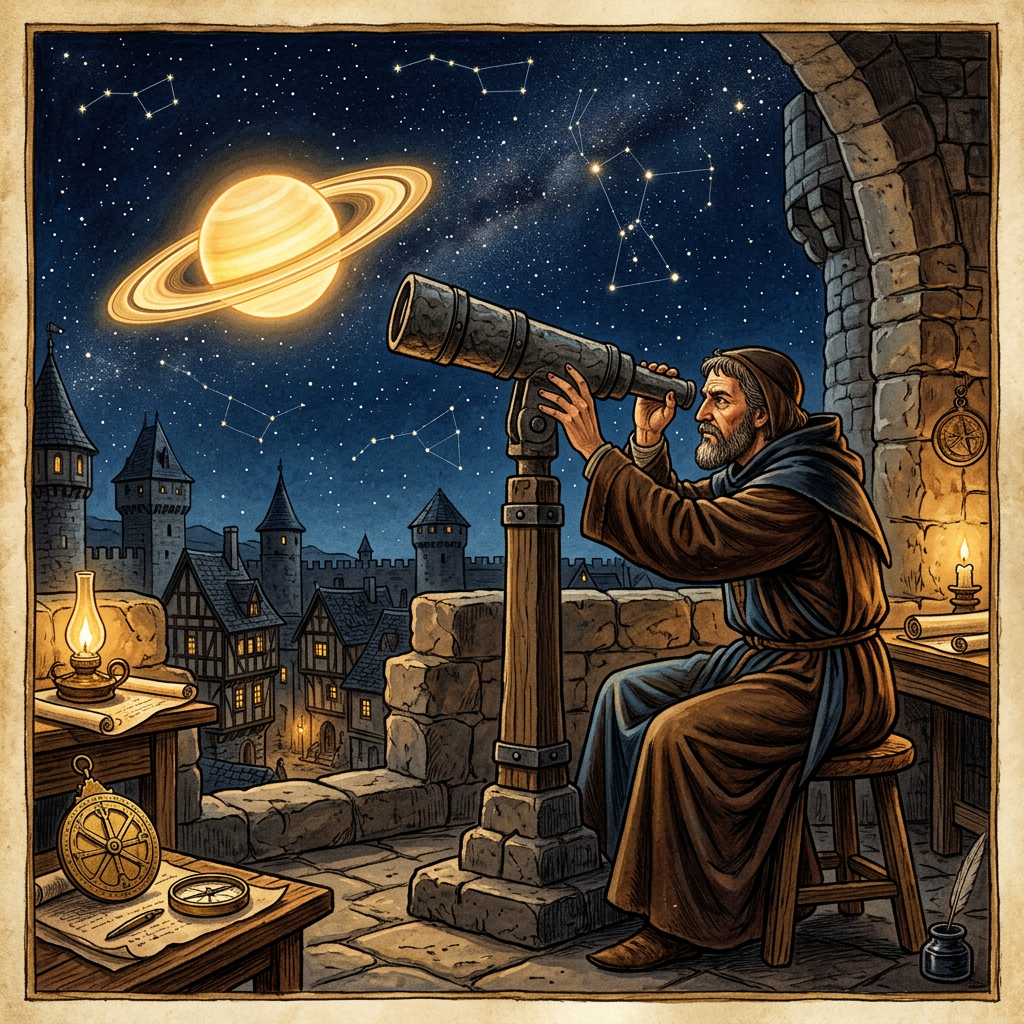
A new research project focused on the Jyotir-Malika, a rare 14th-century astronomical manuscript, has uncovered advanced mathematical models for predicting atmospheric disturbances observed on the planet Saturn. Published in the Indian Journal of Theoretical Astronomy, the study shows that Sanskrit scholars used complex recursive formulas to account for the perceived changes in planetary brightness and color during specific orbital configurations.
The computational analysis identifies the use of stochastic matrices to model variations in the "spheres of the outer orbs," which modern astrophysicists interpret as early attempts to describe planetary atmospheric lensing and light scattering. These findings suggest that late medieval Indian astronomy had moved beyond purely positional models to include phenomenological physics. This study highlights the sophisticated analytical tools developed by the Kerala school to handle non-linear observational data.