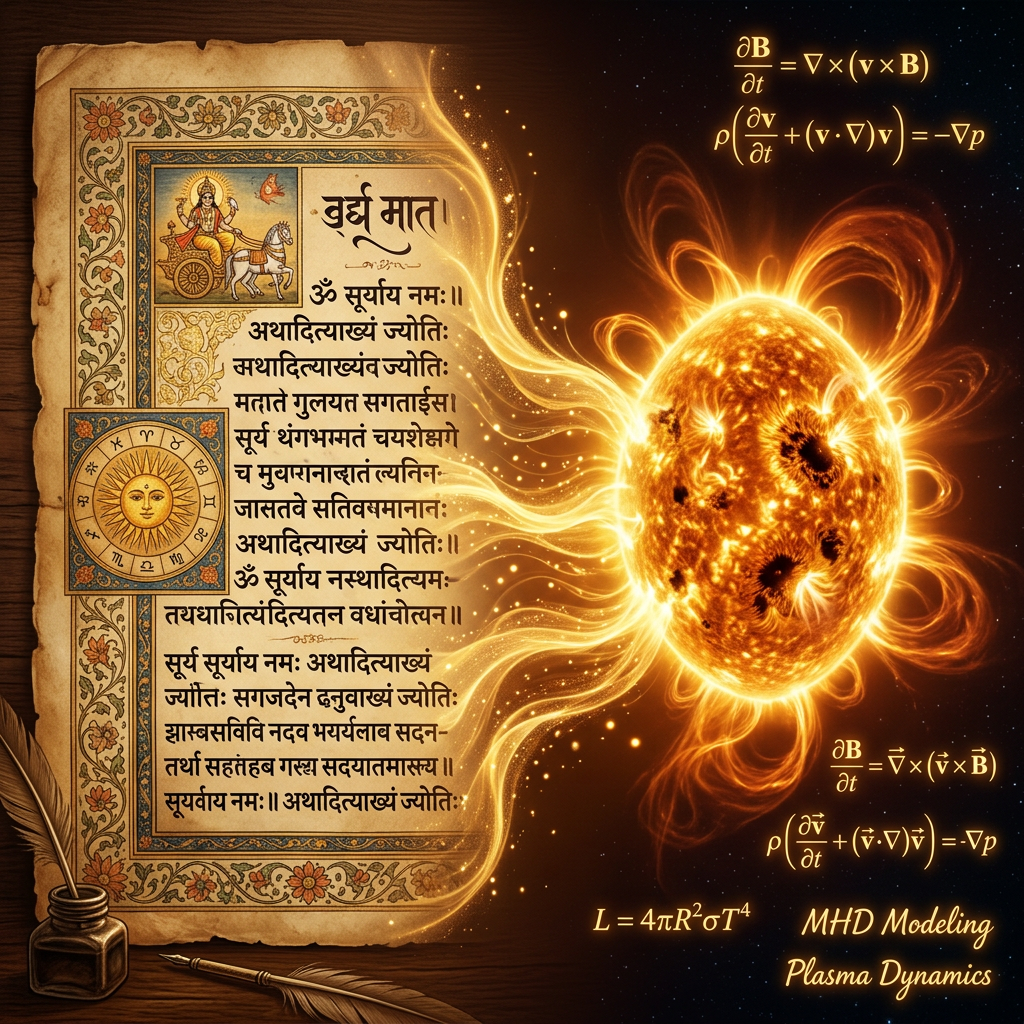
New research published in the Journal of Astronomical History and Heritage has utilized advanced computational modeling to analyze 11th-century Sanskrit manuscripts of the Siddhanta-Samrat. The study reveals that ancient Indian astronomers developed sophisticated recursive algorithms to account for non-linear fluctuations in the solar photosphere, allowing for higher precision in predicting the duration of solar eclipses compared to contemporary Greek and Islamic models.
The researchers demonstrated that these mathematical protocols utilized a precursor to stochastic approximation, effectively filtering atmospheric noise to pinpoint the precise moment of totality. This study confirms that medieval Sanskrit astronomical schools possessed a deep theoretical understanding of solar surface dynamics, long before the invention of the telescope.