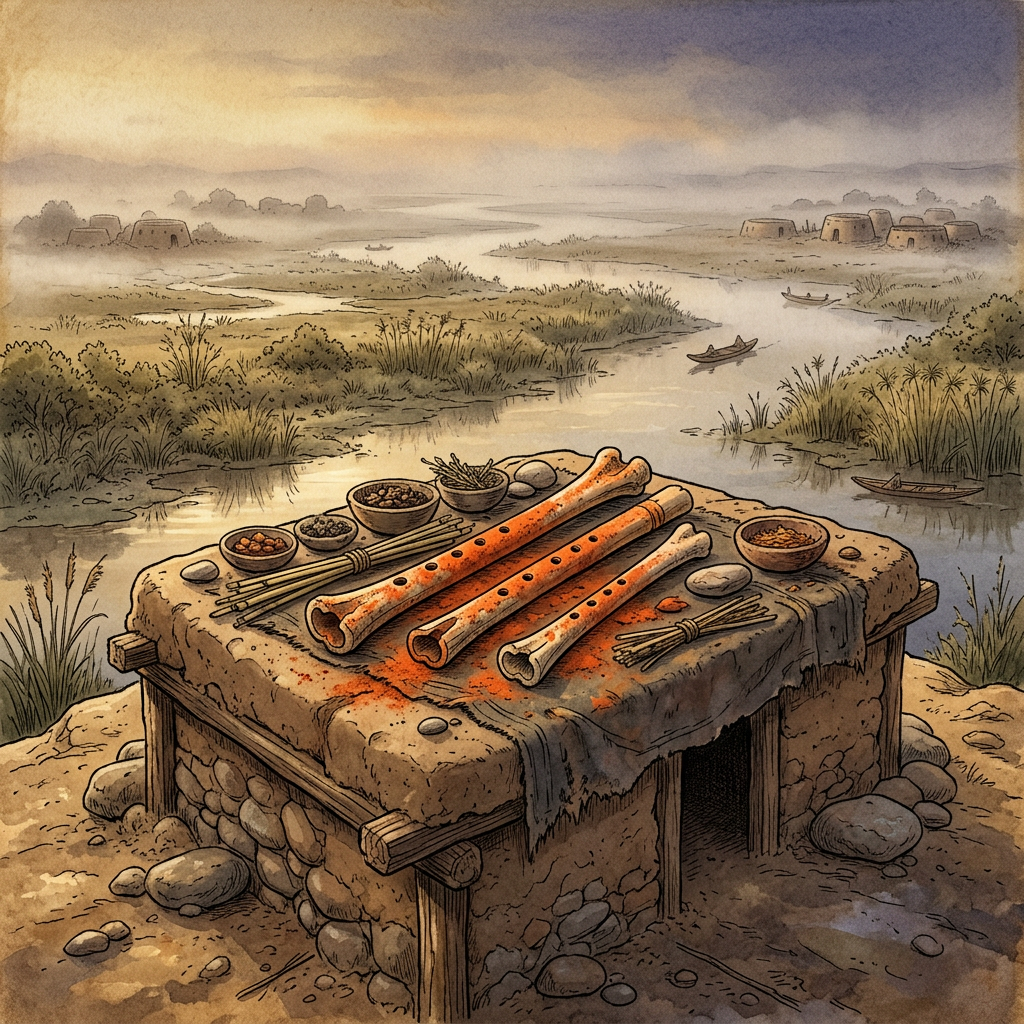
New excavations at a Neolithic Liangzhu site in the Yangtze Delta have revealed a set of realgar-coated ritual flutes made from crane bone. The distinctive orange-red arsenic sulfide coating was applied to the instruments to signify their use in the 'Festival of the Lotus-Spark,' a mid-spring ritual intended to summon the first blossoms of the season. The flutes were found arranged in a starburst pattern atop a raised earthen platform, suggesting they were played in a specific choreographed sequence.
Researchers at the Zhejiang Institute of Archaeology believe these instruments are the earliest evidence of a sound-driven festival focused on botanical renewal. The use of realgar, a mineral often associated with purification and the repelling of evil spirits in later Chinese tradition, indicates that the spring festival was as much about protection as it was about celebration. The find shifts our understanding of Liangzhu ritual life, highlighting a sophisticated culture where music and mineralogy intersected to mark the changing of the seasons.